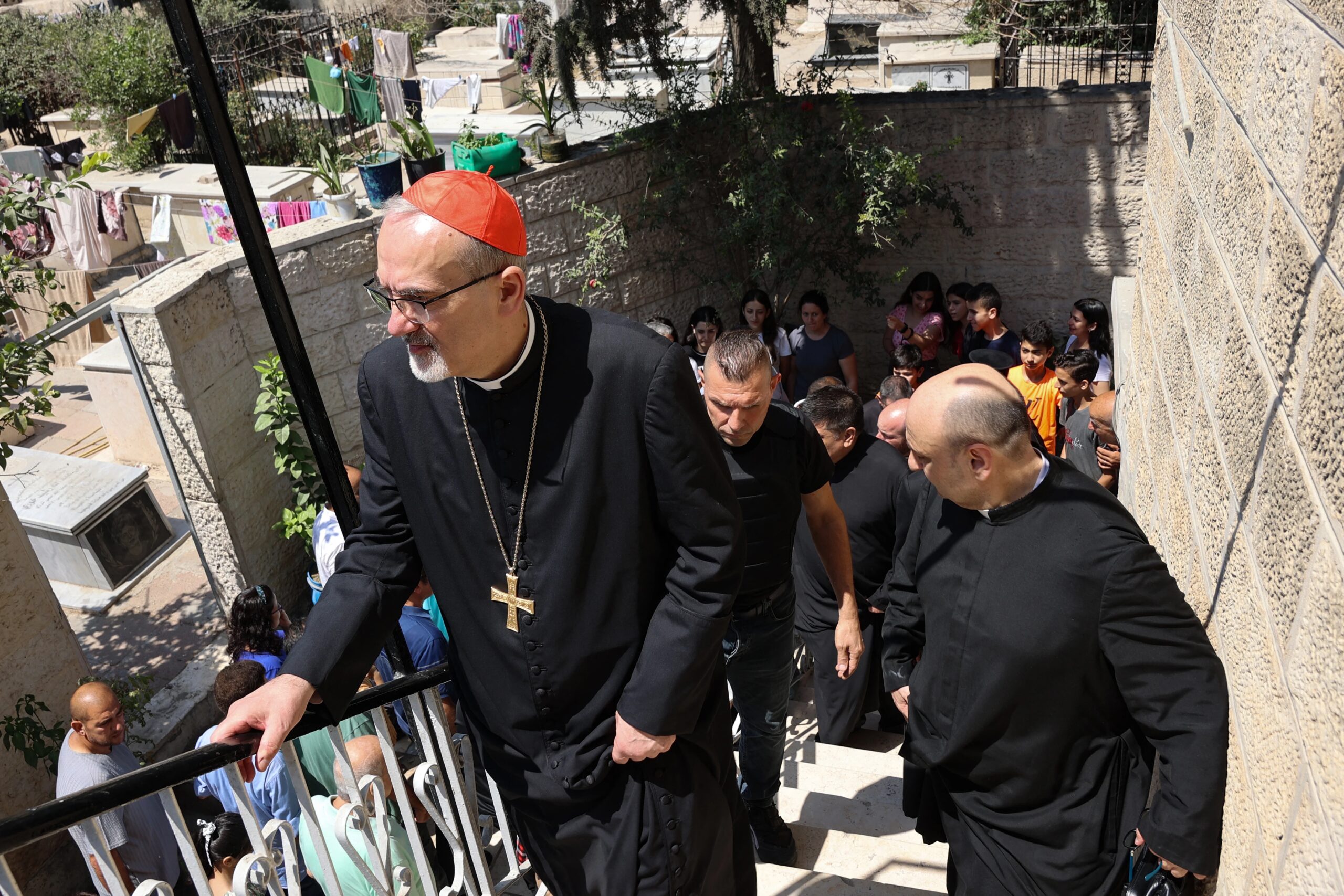
Latin Patriarch of Jerusalem speaks out after first phase of peace deal completed
Catholic News Agency |
15 October 2025
Latin Patriarch of Jerusalem Pierbattista Pizzaballa (L) and a members of a Christian visit the Saint Porphyrius Church in Gaza City on July 18, 2025. / Credit: OMAR AL-QATTAA/AFP via Getty Images
Washington, D.C. Newsroom, Oct 15, 2025 / 17:51 pm (CNA).
Cardinal Pierbattista Pizzaballa has given an update on the status of Christians in Gaza after the first phase of the historic peace deal between Israel and Hamas began this week.
“We are in daily contact with them,” the Latin Patriarch of Jerusalem said of the Catholic community in Gaza in a Vatican News interview. “They keep writing that they still cannot believe they were able to sleep through the night without hearing the sound of bombs.”
Despite the promising outcome of the first phase of the peace deal, which saw the return of Israeli hostages and the strategic withdrawal of IDF troops from Gaza, Pizzaballa emphasized that the situation in Gaza “remains very fluid.” Amid de-escalation between Israel and Hamas forces, clashes among warring factions have broken out across Gaza. Furthermore, he said, “we still do not know if [the war] has truly ended,” and the way forward is not yet clear.
“The situation remains dramatic because everything is destroyed,” he explained. “People are returning, but they are returning to the ruins. Hospitals are not functioning; schools do not exist. There is still the matter of the bodies of the deceased Israeli hostages that must be recovered.”
“However, despite all this, there is a new atmosphere — still fragile, but we hope it will become more stable,” he continued.
Throughout the conflict, Pizzaballa said Catholics in the region have “felt the closeness” of both Pope Leo XIV and Pope Francis. “They have different personalities, but both expressed their closeness in very concrete ways,” he said, noting both pontiffs had made a habit of frequent phone calls and contact with Father Gabriel Romanelli of Holy Family Parish in Gaza, in addition to concrete aid. Pope Leo sent antibiotics into Gaza this week.
The cardinal said, “we must not confuse hope with a solution to the conflict,” while discussing how the region must move forward. “The end of the war is not the beginning of peace, nor is it the end of the conflict,” he said. Rather, fraternity must be built throughout the region, with new political and religious leadership “who can help rebuild a different narrative, one based on mutual respect.”
While Pizzaballa said he did not know whether a two-state solution “is achievable in the short term,” he emphasized the need for Palestinians to not only be helped and supported financially, but to be “recognized in their dignity as a people.”
“One cannot tell the Palestinians that they have no right to be recognized as a people in their own land,” he said. “There have been declarations — often only theoretical — that must find concrete realization within the context of dialogue between the parties, which they themselves will have to reach, with the help and support of the international community.”
Cardinal Tagle celebrates 80th anniversary of Hong Kong diocese
Cardinal Luis Antonio Tagle marks 80 years since the establishment of the Diocese of Hong Kong and encourages the more than 400,000 Catholics to “bring hope to society” and become “courageous witnesses of the Lord”.
By Kielce Gussie
To mark the 80th anniversary of the establishment of the Diocese of Hong Kong, a celebration with prayer, song, and music brought people together from across the diocese.
“May the Holy Face of Jesus always shine upon Hong Kong”, Cardinal Luis Antonio Gokin Tagle said, at the event at the Charter Garden in Hong Kong on January 18.
The Cardinal Pro-Prefect of the Dicastery for Evangelization explained the Biblical origin and nature of the Christian practice of blessing. Following the explanation, he blessed everyone present and the entire city—together with the Jesuit Cardinal Stephen Chow Sau-yan, Bishop of Hong Kong.
Encountering the Face of Jesus
According to the Vatican’sFides news agency, the Pro-Prefect specifically drew inspiration from the blessing found in the Book of Numbers (“The Lord let his face shine upon you and give you peace”). He offered it as “the blessing that God desires to give us”—that His face shine upon men and women throughout all ages.
“The blessing that God gives us and to Hong Kong is His Holy Face in Jesus Christ”, Cardinal Tagle noted. It is a face that is both “fully divine and fully human”.
He also explained that it is also possible to encounter the Face of Jesus through the face of a child as they “are always a blessing for society”. The Pro-Prefect stressed that “no child or young person is a ‘problem’”.
The true blessing for Hong Kong, therefore, is “the face of God that shines upon it”. Cardinal Tagle expressed his hope that the face of Jesus will always shine on Hong Kong and that Hong Kong may always rejoice in His face.
In this spirit, people will be encouraged to “bring hope to society”, becoming “courageous witnesses of the Lord”.
A blessing to others
In his address, the Pro-Prefect encouraged everyone in Hong Kong to foster these “blessings”, acknowledging that all have the ability to become “a blessing to others".
At the ceremony, people and groups from various nationalities and backgrounds prayed for Hong Kong in different languages: Cantonese, Filipino, French, Mandarin, Korean, and Vietnamese.
According to the local diocesan weekly, The Sunday Examiner, Cardinal Tagle also met with two religious sisters—Sister Corazon Demetillo and Sister Victoria Victorino of the Diocesan Pastoral Center for Filipinos—during his short stay in Hong Kong.
The women shared the initiatives different local parishes have promoted to cultivate the integration of migrants. Additionally, they spoke about the support the diocese has offered to asylum seekers and refugees, together with the Philippine Consulate.
Hong Kong is home to a large Filipino community. Data updated on August 31, 2021, revealed that about 177,000 Filipinos are part of the non-permanent residents living in Hong Kong. A number of these Filipino Catholics participated in the anniversary celebration.
Of the more than 7.4 million permanent residents in Hong Kong, over 400,000 are Catholic.
Thank you for reading our article. You can keep up-to-date by subscribing to our daily newsletter. Just click here
Aid convoy arrives in of Ain al-Arab amid humanitarian concern
A United Nations convoy carrying aid arrives in the Kurdish-majority town of Ain al-Arab in northern Syria as a ceasefire between the Syrian army and the Kurdish-led Syrian Democratic Forces continues to hold.
By Nathan Morley
A United Nations convoy carrying aid has arrived in the Kurdish-majority town of Ain al-Arab in northern Syria as a ceasefire between the Syrian army and the Kurdish-led Syrian Democratic Forces continues to hold.
The convoy reached Ain al-Arab, also known as Kobane, on Sunday amid growing concern about humanitarian conditions in the town, which has been surrounded by Syrian government forces.
A United Nations convoy carrying aid has arrived in Ain al-Arab in northern Syria (AFP or licensors)
Separately, United Nations agencies have regained limited access to Syria’s Al Hol camp and resumed the delivery of essential supplies after days of disruption caused by a volatile security situation.
The U.N. refugee agency, UNHCR, accessed the camp on Friday with Syrian government officials and established contact with some residents. Essential supplies have also resumed.
Al Hol is one of the region’s largest displacement sites, housing tens of thousands of people, mostly women and children, many with alleged family links to ISIL fighters. U.N. agencies have long warned of overcrowding, poor access to healthcare, water and sanitation, and ongoing protection and security risks.
Listen to Nathan Morley's report
They have repeatedly urged durable solutions, including safe returns, reintegration and repatriation in line with international law.
The camp in northeast Syria hosts internally displaced Syrians and family members of suspected former fighters. U.N. agencies and aid partners reaffirmed their commitment to supporting Syrian authorities in delivering humanitarian assistance, while underscoring the need to ensure security inside the camp.
They also highlighted the importance of facilitating the movement of personnel and supplies between Al-Hasakeh and Qamishli.
Thank you for reading our article. You can keep up-to-date by subscribing to our daily newsletter. Just click here
Restoration of Bethlehem’s Grotto of the Nativity ‘a sign of hope and unity’
The Greek Orthodox Patriarchate of Jerusalem and the Custody of the Holy Land announce that works are set to begin to restore the “cradle” of Christianity—the place where Jesus was born—in Bethlehem.
By Cecilia Seppia
In Bethlehem, everything is ready to begin the restoration works of the Grotto of the Nativity, occurring for the first time in 600 years.
The announcement was made jointly by the Greek Orthodox Patriarchate of Jerusalem and the Custody of the Holy Land. They expressed their joy at the initiative, which also involves the cooperation of the Armenian Apostolic Orthodox Patriarchate and is carried out under the auspices of the Presidency of the State of Palestine.
Palestinian President Mahmoud Abbas had referred to the restoration works while visiting Rome in November 2025, both during his meeting with Pope Leo XIV and at the inauguration of the exhibition "Bethlehem Reborn." He said that the renovation of the place where Christ was born was “a sign of great hope and rebirth for the whole Holy Land.”
Thus, in compliance with the presidential decree on the restoration of the site already issued in 2024, and with the historic status quo governing the holy places, the Grotto—venerated across Christian faiths—will finally receive the care it needs.
Project entrusted to an Italian company
The works will be carried out by an Italian company from Prato, which only two years ago restored the Basilica of the Nativity, according to a major and meticulous rehabilitation project.
The choice is based on the need to ensure continuity of method, craftsmanship, and artistic sensitivity toward a site of unparalleled sacred value. According to the Custody’s website, the preliminary preparations have been completed, and the works are now about to begin.
In addition to interventions in the Grotto itself—on the bare rock, the marble floors, columns and decorations, and the star marking the exact spot where Jesus was born—the project includes technical reinforcement measures in adjacent sections. This reflects both the architectural unity of the sanctuary and the spirit of cooperation that preserves it for all humanity.
The restorations will also provide support for many local families of workers (trained in restoration) who will be employed in this important project, and consequently will have an impact on Bethlehem’s economy.
The economic situation has been difficult due to the conflict between Israel and Hamas and the halt in pilgrimages, which are now slowly resuming as “Phase 2” of US President Donald Trump’s peace plan gets underway.
In the sign of unity
A sign of rebirth, therefore, but also a strong ecumenical initiative, marked by collaboration between Greek Orthodox Christians and the Franciscans, custodians of the Grotto.
“This project,” the statement continues, “embodies a unified Christian commitment to preserve the spiritual, historical, and cultural patrimony of the Holy Grotto for future generations, and to uphold the dignity of a site where the Christian proclamation took visible form and where the faithful of every nation have gathered in pilgrimage throughout the centuries.”
“In the Grotto, the mystery of the Incarnation entered history, and the Christian confession received its earthly beginning. To restore this holy place is to safeguard the continuity of faith, memory, and devotion in the land of the Nativity,” the statement explains.
“Through this collective effort, the Churches of Jerusalem protect the Gospel heritage entrusted to them and ensure that the faithful of all traditions may continue to venerate the birthplace of Christ with reverence. From Bethlehem, the light of the Nativity continues to illuminate the world, bearing witness to the enduring Christian presence in the Holy Land and to the hope that radiates from the sacred cave where the Savior was born.”
Thank you for reading our article. You can keep up-to-date by subscribing to our daily newsletter. Just click here
Pope to Roman Rota: Justice and charity find harmony in mystery of God
Pope Leo XIV meets officials of the Tribunal of Roman Rota for the inauguration of their judicial year, and urges them to safeguard the truth with rigor but without rigidity and to exercise charity without omission.
By Deborah Castellano Lubov
"You are called to safeguard the truth with rigor but without rigidity, and to exercise charity without omission."
Pope Leo XIV made this invitation to the prelate auditors of the Tribunal of Roman Rota in the Vatican on Monday, as he inaugurated its Judicial Year.
The Tribunal of the Roman Rota ordinarily acts as an appellate court of higher instance at the Apostolic See, with the purpose of safeguarding rights within the Church. It fosters unity of jurisprudence and, by virtue of its decisions, provides assistance to lower tribunals.
The Tribunal also includes the Office competent to adjudicate the fact of the non-consummation of marriage and the existence of a just cause for granting dispensations. This Office is also competent to deal with cases of the nullity of sacred ordination, pursuant to the norm of universal and proper law, in accordance with the different cases. It has a collegiate structure and is composed of a certain number of judges of proven doctrine, competence, and experience selected by the Pope from various parts of the world.
Precious service
The Pope began by thanking them for their work, "which is a precious service to the universal judicial function that belongs to the Pope and in which the Lord has called you to share," noting that the expression “Veritatem facientes in caritate” (The truth in love) (Eph 4:15), "can be applied to your daily mission in the administration of justice."
He thanked those present in the audience and everyone working in Church tribunals throughout the world, noting, "The ministry of judge that I have had occasion to exercise enables me to understand your experience more deeply and to appreciate the ecclesial significance of your task."
Pope Leo then returned to a fundamental theme that has been central in the addresses delivered to the Tribunal of the Roman Rota from Pope Pius XII up to Pope Francis, concerning the relationship of their activity "with the truth that is intrinsic to justice."
"On this occasion," the Pope said, "I intend to offer you some reflections on the close bond that exists between the truth of justice and the virtue of charity," clarifying they "are not two opposing principles, nor values to be balanced according to purely pragmatic criteria, but two dimensions intrinsically united, which find their deepest harmony in the very mystery of God, who is Love and Truth."
This correlation, he stated, calls for constant and careful critical discernment, "since, in the exercise of judicial activity, a dialectical tension not infrequently emerges between the demands of objective truth and the concerns of charity."
A delicate balance
"At times," Pope Leo said, "there is the risk that excessive identification with the often troubled circumstances of the faithful may lead to a dangerous relativization of the truth."
"Indeed, a misguided compassion, even when apparently motivated by pastoral zeal," Pope Leo said, "risks obscuring the necessary dimension of ascertaining the truth that is proper to the judicial office."
"This," he continued, "can occur not only in cases of matrimonial nullity—where it might lead to decisions of a pastoral character lacking a solid objective foundation—but also in any type of proceeding, thereby undermining its rigor and equity."
On the other hand, he cautioned, "there can sometimes be a cold and detached affirmation of the truth that fails to take into account all that love for persons requires, omitting those concerns dictated by respect and mercy, which must be present at every stage of a process."
In considering the relationship between truth and charity, Pope Leo insisted that St. Paul offered "clear guidance" when exhorting in his Letter to the Ephesians that, “Living the truth in love, we should grow in every way into Him who is the head, Christ.”
"Veritatem facientes in caritate," Pope Leo reiterated, "does not mean merely conforming to a speculative truth, but “doing the truth,” that is, a truth that must illuminate the whole of one’s actions. And this must be done “in charity,” which is the great driving force that leads to the practice of true justice."
Not a tension between opposing interests, but an instrument for discernment
The process, Pope Leo said, "is not in itself a tension between opposing interests, as is sometimes mistakenly thought, but the indispensable instrument for discerning truth and justice in a given case."
The Pope went on to discuss the adversarial nature of judicial proceedings, and delineated the rigorous elements needed to properly assess these delicate situations and to ascertain appropriately the truth.
"Failure to observe these basic principles of justice—and the fostering of unjustified disparities in the treatment of similar situations—constitutes a serious injury to the juridical dimension of ecclesial communion."
The Pope also addressed the shorter process for the declaration of matrimonial nullity before the diocesan Bishop.
Here, he said, "the apparently manifest nature of the ground of nullity that makes this procedure possible must be assessed with great care, without forgetting that it will be the duly conducted process itself that must confirm the existence of nullity or determine the need to have recourse to the ordinary process."
With all this in mind, the Holy Father underscored, "it therefore proves fundamental that the study and application of canonical matrimonial law continue with scientific seriousness and fidelity to the Magisterium."
Praying that the true wisdom of Christian law must be made manifest, Pope Leo XIV entrusted their work to the intercession of the Blessed Virgin Mary, Speculum iustitiae, "the perfect model of truth in charity."
Pope Leo XIV meets officials of the Tribunal of Roman Rota for the inauguration of their judicial year, (@Vatican Media)
Thank you for reading our article. You can keep up-to-date by subscribing to our daily newsletter. Just click here
Zayed Award names Palestinian organization Taawon as third honoree
The Zayed Award for Human Fraternity has named the Palestinian organization Taawon as the third honoree of its seventh edition, recognizing the non-profit for its decades-long humanitarian and development work across the region.
By Deborah Castellano Lubov
The Zayed Award for Human Fraternity announced on Monday that the Palestinian non-profit organization Taawon will be third honoree of its seventh edition.
During the annual award ceremony at the Founder's Memorial in Abu Dhabi on February 4, 2026, the organization, established in 1983, will be honored alongside the first and second honorees.
Palestinian organization Taawon was selected in recognition of its exceptional humanitarian and developmental work, which touches the lives of over one million Palestinians annually across the West Bank, Gaza, and refugee camps in Lebanon.
Since its founding, Taawon has invested more than USD $1 billion across various initiatives, including education, youth empowerment, orphan care, cultural projects, rehabilitation of historic towns, and community development, including health, agriculture, and emergency humanitarian assistance.
The organization has implemented over 8,200 projects that support Palestinians, particularly young people, in strengthening resilience, advancing opportunities, and elevating communities economically, socially, and culturally, while at the same time preserving Palestinian heritage, promoting sustainable development, and showcasing enduring civilization and renewed creativity.
The Chairman of Taawon’s Board of Directors, Dr. Nabil H. Qaddumi, expressed gratitude to the award’s judging committee, comprised of a global panel of experts in advancing dialogue and human coexistence.
Last week, the Zayed Award judges named the historic peace agreement between the Republic of Azerbaijan and the Republic of Armenia as the first honoree and Afghan girl's advocate, Zarqa Yaftali as the second.
President Ilham Aliyev of the Republic of Azerbaijan and Prime Minister Nikol Pashinyan of the Republic of Armenia expressed their pride in the joint recognition contributing to strengthening efforts to advance peace in the Caucasus region.
Since 2019, the award has honored 20 recipients from 20 countries, recognizing international institutions and figures that have made outstanding contributions to promoting and advancing the values of human fraternity worldwide.
Thank you for reading our article. You can keep up-to-date by subscribing to our daily newsletter. Just click here
Athletica Vaticana to bring Olympic Cross to Milan for Winter Games
On January 29, Athletica Vaticana will deliver the Olympic and Paralympic Cross at a Mass at the Basilica of San Babila, which will serve as the “Church of Athletes” throughout the Winter Games.
By Giampaolo Mattei
Since the London 2012 Games, the Olympic and Paralympic Cross has accompanied athletes. The upcoming Milan-Cortina Winter Games will be no different.
The Milan-Cortina Olympic and Paralympic Games are set to begin on February 6 (AFP or licensors)
On Thursday, January 29, at 6:30 PM, Athletica Vaticana—the official sports association of the Holy See—will present the Cross during a Mass at the Basilica of San Babila in Milan.
Archbishop Mario Delpini of Milan will preside with Bishop Paul Tighe, Secretary of the Dicastery for Culture and Education, and the president and vice-president of Athletica Vaticana will also be present.
The “Church of Athletes”
The Mass marks the eve of the Olympic Truce, which—according to the resolution adopted by the United Nations General Assembly on November 19—will last from one week before the Olympic Games (starting February 6) to one week after the Paralympic Games (the closing ceremony on March 15).
During this entire period, the Basilica of San Babila will be transformed into the “Church of Athletes,” hosting various celebrations and events linked to the Games.
Bringing the Cross through the Holy Door
The Cross of Athletes was entrusted to Athletica Vaticana on June 14 during the Jubilee of Sport with Pope Leo XIV. It is a spiritual symbol at the heart of global sports.
Thomas Bach, the President of the International Olympic Committee, together with Cardinal José Tolentino de Mendonça, Prefect of the Dicastery for Culture and Education, carried the Cross through the Holy Door of St. Peter’s Basilica.
The Olympic and Paralympic Cross
Athletica Vaticana then received the Cross from a delegation from Paris, who had been sent particularly for the Jubilee, in connection with the 2024 Games. The moment of prayer marked the beginning of the Jubilee pilgrimage from Piazza Pia along the Via Conciliazione to the Holy Door of St. Peter’s.
One cross with wood from around the world
The Cross of Athletes was made by English artist Jon Cornwall specifically for the 2012 London Games. This was at the request of the coordination of Catholic initiatives in the Joshua Camp, an international Catholic Olympic gathering.
Fifteen different pieces of wood (including the podium that supports it) make up the Cross. Each piece has been carefully chosen from regions across the world: the Holy Land, China, Russia, North Africa, South Africa, India, Australia, Brazil, Argentina, Jamaica, North America, and the United Kingdom.
From London to Milan
At the closure of the 2012 London Games, the Cross was entrusted to the Archdiocese of Rio de Janeiro for the 2016 Olympics and Paralympics.
During the 2013 World Youth Day (WYD) in Brazil, Pope Francis blessed the Cross, which was later present at the 2014 FIFA World Cup in Rio.
Due to the COVID pandemic, no events were held for the Tokyo 2020 Games. Instead, the Cross was brought to Lisbon for the 2023 WYD before being placed in Paris in the “Chapel of Athletes” at the Church of La Madeleine.
Thank you for reading our article. You can keep up-to-date by subscribing to our daily newsletter. Just click here
US Bishops urge respect for human life after Minneapolis killings
In the wake of two recent killings by federal immigration agents in Minneapolis, US Bishops call for restraint, peace, and respect for every human life.
By Devin Watkins
Tensions are running high in the US city of Minneapolis, Minnesota, after US Immigration and Customs Enforcement (ICE) agents fatally shot Alex Pretti, a 37-year-old intensive care nurse and US citizen, on Saturday.
The federal government alleged that Mr. Pretti was carrying a gun and intervened as ICE agents confronted a woman on the street.
Local authorities said Mr. Pretti had a permit to carry a handgun in public, adding that his firearm was legally registered.
Video from the scene shows Mr. Pretti holding a phone, not a gun, as he assists other protesters. ICE agents are seen forcing Mr. Pretti to the ground, and one agent removes a gun from him and steps away. Another officer then points a handgun at Mr. Pretti’s back and fires four shots in quick succession.
Thousands of protesters took to the streets of Minneapolis the next day, and several vigils were held for Mr. Pretti over the weekend.
His death came just over two weeks after ICE agents killed 37-year-old mother Renee Good in Minneapolis.
Bishops’ call for prayers and peace
On Sunday, Archbishop Bernard Hebda, Archbishop of Minneapolis, released a statement calling for prayers for Mr. Pretti and his loved ones.
“The loss of another life amidst the tensions that have gripped Minnesota should prompt all of us to ask what we can do to restore the Lord’s peace,” said the Archbishop.
He recalled that all people were created in the image and likeness of God, both elected US officials and “our undocumented neighbors.”
“While we rightly thirst for God’s justice and hunger for his peace,” said Archbishop Hebda, “this will be not be achieved until we are able to rid our hearts of the hatreds and prejudices that prevent us from seeing each other as brothers and sisters created in the image and likeness of God.”
The Archbishop invited Catholics to join in prayer before the Blessed Sacrament in the city’s churches, which he said offer a “quiet place for prayer and reflection.”
Separately, Archbishop Paul Coakley, President of the US Catholic Bishops’ Conference, called for Americans to come together in dialogue and turn away from “dehumanizing rhetoric and acts which threaten human life.”
“I prayerfully urge calm, restraint, and respect for human life in Minneapolis, and all those places where peace is threatened,” he said in a statement released on Sunday. “Public authorities especially have a responsibility to safeguard the well-being of people in service to the common good.”
“Pope Leo XIV reminds us that ‘the Gospel must be proclaimed and lived in every setting, serving as a leaven of fraternity and peace among all individuals, cultures, religions and peoples’,” said the Archbishop.
In conclusion, Archbishop Coakley proclaimed, with Pope Leo, that “peace is built on respect for people.”
Federal court hearing could reduce ICE presence in Minnesota
US President Donald Trump told the Wall Street Journal on Sunday that his administration is reviewing the fatal shooting.
He also hinted he would be willing to eventually withdraw ICE agents from the Minneapolis area, but did not offer a time frame.
Meanwhile, a federal judge is set to hear arguments on Monday in a case that could temporarily halt the government’s immigration crackdown in Minnesota.
Minnesota sued the Department of Homeland Security earlier this month to restore the numbers of federal law enforcement agents deployed in the state to pre-December 2025 levels, when the Trump Administration launched Operation Metro Surge.
Thank you for reading our article. You can keep up-to-date by subscribing to our daily newsletter. Just click here
Pope at Ecumenical Vespers: We are one, let’s make it visible
On the feast of the Conversion of St Paul, which marks the close of the Week of Prayer for Christian Unity, Pope Leo invites Christians to continue on their shared mission of spreading the Gospel to all.
By Isabella H. de Carvalho
Pope Leo emphasized how different Christian religions share the same faith and encouraged them to continue together the mission of spreading the Gospel throughout the world, on Sunday, January 25, 2026, at the conclusion of the Week of Prayer for Christian Unity.
“We are one! We already are! Let us recognize it, experience it and make it visible!” he said in his homily during the celebration of Second Vespers on the Feast of the Conversion of St. Paul, marking the end of the Week of Prayer.
He pointed out that this annual event reminds Christians of their commitment to the mission of spreading the Gospel, “bearing in mind that the divisions among us – while they do not prevent the light of Christ from shining – nonetheless make the face which must reflect it to the world less radiant.”
The service was celebrated at the Basilica of St. Paul Outside the Walls in Rome, the resting place of the Apostle. The Week of Prayer for Christian Unity takes place every year in the northern hemisphere from January 18 to 25.
Several representatives of various Christian Churches were present, including Metropolitan Polykarpos, representing the Ecumenical Patriarchate of Constantinople, Archbishop Khajag Barsamian, from the Armenian Apostolic Church, and Bishop Anthony Ball, of the Anglican Communion. There was also Cardinal Kurt Koch, Prefect of the Dicastery for Promoting Christian Unity, along with other ecumenical groups and pilgrims.
Pope Leo at St Paul's Outside the Walls (@VATICAN MEDIA)
St. Paul, an example for all Christians in their mission
In the passage from St. Paul’s Letter to the Ephesians, chosen as the theme for this year’s Week of Prayer, “we repeatedly hear the adjective 'one': one body, one Spirit, one hope, one Lord, one faith, one baptism, one God,” the Pope explained in his homily.
“Dear brothers and sisters, how can these inspired words not touch us deeply? How can our hearts not burn within us when we hear them?” he asked, underlining how we share the same faith in God, Jesus Christ and the Holy Spirit.
He pointed to St. Paul’s conversion, from a persecutor of the Church to someone who preached Jesus’s “love with burning zeal,” as an example. As the participants of the Vespers gathered before the tomb of the Apostle, Pope Leo highlighted that it served as a reminder that his mission is the same as that of all Christians: “to proclaim Christ and to invite everyone to place their trust in him.”
The Pope also cited the Second Vatican Council’s Constitution Lumen Gentium, in which the Church “expressed its ardent desire to proclaim the Gospel to all creation” and thus “bring to all humanity that light of Christ which is resplendent on the face of the Church.”
“It is the shared task of all Christians to say humbly and joyfully to the world: ‘Look to Christ! Come closer to him! Welcome his word that enlightens and consoles!’,” the Pope insisted.
Pope Leo at St Paul's Outside the Walls (@VATICAN MEDIA)
Commemorating Nicaea and the importance of synodality
The Pope also recalled the ecumenical prayer service he celebrated along with various other Christian leaders in Iznik, Türkiye, in November 2025, to commemorate the 1700th anniversary of the Council of Nicaea.
“Reciting the Nicene Creed together in the very place where it was formulated was a profound and unforgettable testimony to our unity in Christ,” the Pope said.
“May the Holy Spirit find in us docile minds even today, so that we may proclaim the faith with one voice to the men and women of our time!”
Looking instead to the future, Pope Leo mentioned the 2000th anniversary of the passion, death and resurrection of Christ, which will be celebrated in 2033. In light of this event, he called those present to “commit ourselves to further developing ecumenical synodal practices and to sharing with one another who we are, what we do and what we teach.”
Citing Pope Francis, Pope Leo explained how the Catholic Church’s synodal journey is ecumenical and vice versa, and he recalled the participation of several fraternal Christian delegates to the 2023 and 2024 sessions of the Assemblies of the Synod of Bishops at the Vatican.
“I believe this is a path for growing together in mutual knowledge of our respective synodal structures and traditions,” the Pope insisted.
The ecumenical celebration at St Paul's Outside the Walls (@VATICAN MEDIA)
The witness of the Armenian people
Lastly, the Pope mentioned how this year’s materials for the Week of Prayer for Christian Unity were prepared by the Armenian Apostolic Church, along with the local Churches in the country.
“With deep gratitude, we remember the courageous Christian witness of the Armenian people throughout history, a history in which martyrdom has been a constant feature,” he reflected.
He highlighted “Saint Nersès Šnorhali “the Gracious,” the holy Catholicos who worked for the unity of the Church in the 12th century, and was ahead of his time in his ecumenical commitment.
“As my venerable predecessor Saint John Paul II recalled, Saint Nerses also teaches us the attitude we should adopt on our ecumenical journey: ‘Christians must have a profound interior conviction that unity is essential, not for strategic advantage or political gain but for the sake of preaching the Gospel’,” the Pope explained.
Emphasizing how, according to tradition, Armenia was the first Christian nation, “after King Tiridates was baptized by Saint Gregory the Illuminator in the year 301,” Pope Leo thanked “the intrepid heralds of the saving Word who spread the faith in Jesus Christ throughout Eastern and Western Europe.”
“We pray that the seeds of the Gospel may continue to bear fruit on this continent in unity, justice and holiness, for the benefit of peace among the peoples and nations of the whole world,” the Pope concluded.
The ecumenical celebration at St Paul's Outside the Walls (@Vatican Media)
Pope Leo XIV leads Ecumenical Vespers at the Basilica of St Paul Outside the Walls
Thank you for reading our article. You can keep up-to-date by subscribing to our daily newsletter. Just click here
Ukraine: Peace talks end without deal as Russian strikes hit during winter cold
Officials say Ukraine and Russia ended U.S.-brokered peace talks in Abu Dhabi without a deal, though more negotiations are expected next weekend despite ongoing attacks.
By Stefan J. Bos
The talks concluded as overnight Russian airstrikes knocked out electricity for more than a million Ukrainians amid subzero winter cold, reportedly killing at least one person and injuring 23 civilians.
Russia launched a deadly drone and missile attack targeting Ukraine’s two largest cities, Kyiv and Kharkiv, even as U.S., Ukrainian and Russian negotiators met in the United Arab Emirates for trilateral peace talks.
The night sky in Kyiv was lit up by flashes and the sound of explosions as the capital came under massive strikes.
Firefighters rushed to burning vehicles, while authorities said debris damaged several buildings, including the roof of the Roshen chocolate factory.
Clutching children, pets in corridors
In Kharkiv, residents clutched their children and pets as they huddled in corridors, trying to stay warm in freezing temperatures that could drop overnight to minus 20 Celsius, minus 4 Fahrenheit.
Among those sheltering was Olena Artemova, a resident of a damaged building.
“How and where we are to spend the night is unclear,” she says. “The windows are broken, and we have only a one-room apartment.”
Ukraine’s air force said Russia launched hundreds of drones and dozens of missiles in the overnight attack into early Saturday.
‘Strikes also hit negotiating table’
Foreign Minister Andrii Sybiha called it cynical that President Vladimir Putin ordered what he described as “a brutal massive strike” while delegations were meeting in Abu Dhabi.
Sybiha said Russian missiles not only struck Ukraine, but figuratively, “also hit the negotiating table.”
No agreements were announced after the talks. Sticking points include Russia insisting the war cannot end without Ukrainian territorial concessions — especially in the eastern Donbas — demands Kyiv rejects.
Still, both sides said they remain open to further dialogue as early as next weekend. A senior U.S. official even suggested the sides may not be far from higher-level talks between the Ukrainian, Russian and U.S. presidents.
For now, Ukrainians face another bitter winter as the nearly four-year-long war grinds on.
Listen to the report by Stefan Bos
Thank you for reading our article. You can keep up-to-date by subscribing to our daily newsletter. Just click here
Ecumenism at Bossey is not only taught in the classroom. It Is lived, says Rev. Dlamini
Republic of South Africa Methodist Church of Southern Africa minister, Reverend Ntobeko Dlamini, has commended the ecumenical efforts demonstrated by various Christian denominations during the week just ending. Christians around the world have been commemorating the Week of Prayer for Christian Unity. This is an annual, worldwide Christian tradition observed from 18 January to 25 January.
Paul Samasumo – Vatican City
Reverend Ntobeko Dlamini of Durban, a major city on the eastern coast of South Africa, is currently pursuing a Master of Advanced Studies in Ecumenical Studies at the prestigious Ecumenical Institute Bossey in Switzerland. Bossey Institute is part of the World Council of Churches and is affiliated with the University of Geneva.
Commemorating Week of Prayer
Speaking on the sidelines of a visit by the Bossey Institute students to Rome, Reverend Dlamini emphasised the importance of engagement, unity, and understanding among Christians—especially in a world showing tendencies toward division and conflict.
“It is very interesting that we celebrate this week of Christian unity here in Rome. We came here as a group of Bossey students from different Christian confessions. It is important for us because unity is the will of God. And it is Jesus Christ who prayed for unity in John 17: ‘That all may be one...’ In the Bible, we also see the apostles together, united when the Holy Spirit descended upon them as found in the Book of Acts. The early church was once united. It is unfortunate that over the years, divisions have caused the plurality of churches we see today. Fortunately, the ecumenical movement today has awakened to the realisation that visible unity—the will of God—is beginning to come to fruition. I commend the work being done by the World Council of Churches, especially at Bossey, where students and ministers from different denominations worldwide explore how we can live out this unity—this visible, organic unity,” Reverend Dlamini told Vatican News.
Example of the Nicene Creed anniversary
Reverend Dlamini also called upon Christians worldwide to emulate the leaders of various denominations who concretely demonstrated this unity late last year, on 28 November 2025, in Iznik, Turkey (ancient Nicaea), during the 1,700th anniversary of the Council of Nicaea. Pope Leo XIV, Ecumenical Patriarch Bartholomew I, and approximately 27 other Christian leaders gathered as one for this historic event, which will forever be remembered as a significant milestone in ecumenical history. It highlighted the shared faith and the foundational role of the Nicene Creed, established in 325 AD.
Students of the Ecumenical Institute Bossey in Switzerland on visit to Rome, this week
What does the Ecumenical movement mean to Reverend Dlamini as a Methodist minister serving the church in South Africa?
“We saw the leaders of the world’s communions reciting together the Creed of Nicaea. That was very beautiful. It is an indication that the Holy Spirit is indeed leading us toward visible unity. For me, as a Methodist minister—especially in the context of South Africa and its history—it is essential to remain engaged in this work. South Africa, my home country, has experienced segregation. Even after 30 years of democracy, we still witness segregation within our churches. We are still working toward integrating our own churches,” Reverend Dlamini emphasised.
Overcoming cultural challenges
When asked about living daily life alongside people from different denominations at Bossey, Dlamini shared insights into navigating the rich tapestry of national and cultural diversity among students.
“At Bossey, I have had the opportunity to study alongside priests from the Eastern Orthodox and Oriental Orthodox traditions and other Churches. Bossey is very helpful in fostering intercultural integration, where you learn about other denominations and their cultures,” Dlamini explained.
Inevitably, challenges arise. “Sometimes we do frustrate each other, but what matters the most is how we reconcile. In short, at Bossey Institute, you learn to live with those who are different from you. Ecumenism at Bossey is not only taught in the classroom but also lived out. That, for me, is so wonderful,” Reverend Dlamini concluded.
Thank you for reading our article. You can keep up-to-date by subscribing to our daily newsletter. Just click here