‘Peace Be With You!’ First full-length book by Pope Leo XIV set for February release
Catholic News Agency |
5 December 2025
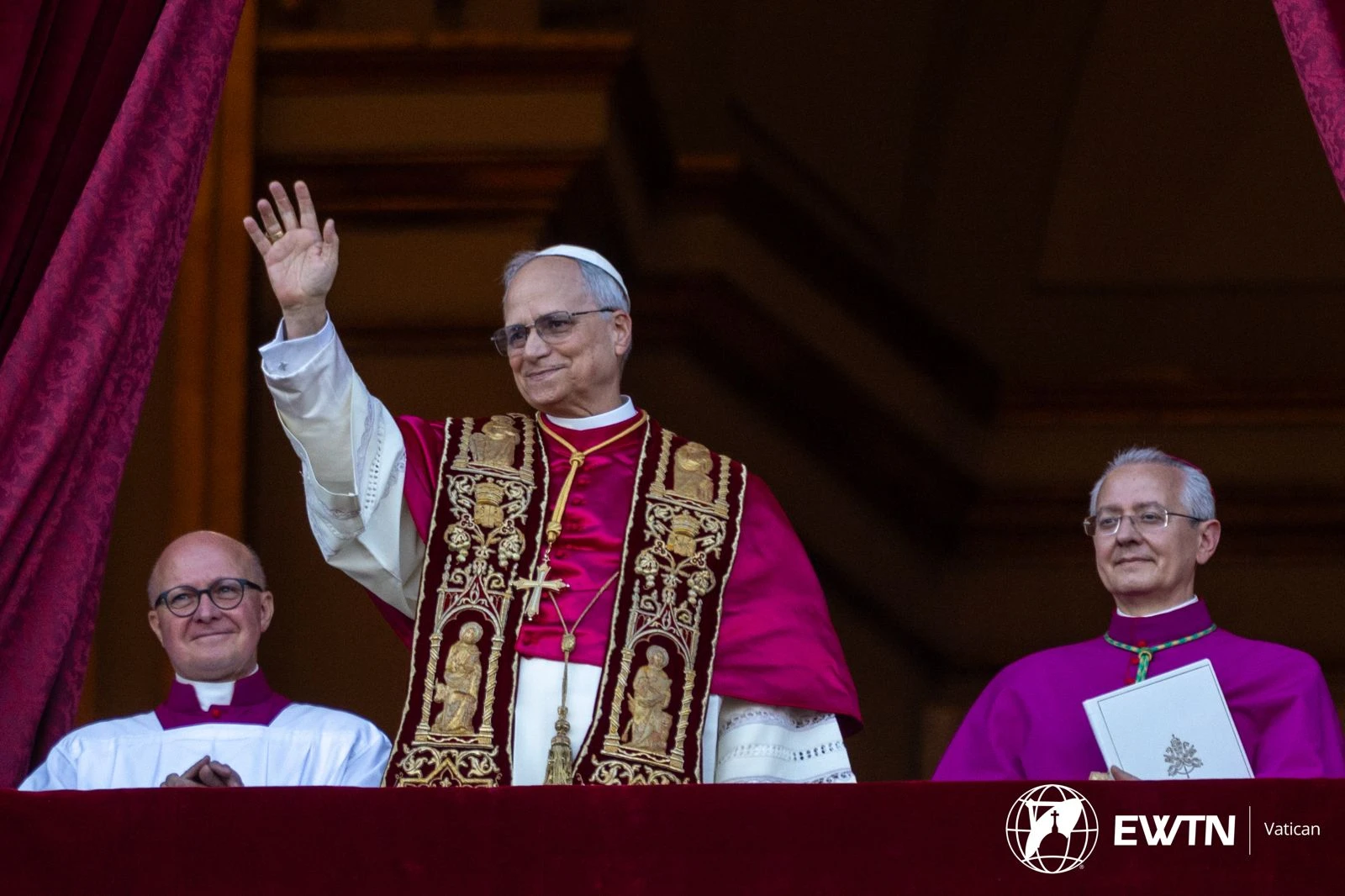
Pope Leo XIV waves to pilgrims in St. Peter’s Square shortly after his election on Thursday, May 8, 2025. / Credit: Daniel Ibáñez/CNA
Washington, D.C. Newsroom, Dec 5, 2025 / 14:08 pm (CNA).
Pope Leo XIV will offer his “vision for peace, unity, and reconciliation” in his first full-length book to be published in February 2026.
The Holy Father’s book, “Peace Be With You: My Words to the Church and to the World,” is set to be published in English and Spanish on Feb. 24 by HarperOne, according to a Dec. 4 press release.
The title of the book recalls the first words spoken by the risen Christ, which also were Leo’s first words as pontiff: “Peace be with you.”
HarperOne releases an image of “Peace Be With You: My Words to the Church and to the World” by Pope Leo XIV, a book expected to be available in February 2026. Credit: Courtesy of HarperOne
“I would like this greeting of peace to resound in your hearts, in your families, among all people, wherever they may be, in every nation and throughout the world. Peace be with you!” Leo said at his first appearance from the central loggia of St. Peter’s Basilica.
The book includes sermons and addresses delivered since his election on May 8, 2025, according to the publisher, which has also distributed works by St. John Paul II and Pope Francis.
“Together, these texts reflect the new pope’s vision and priorities: the primacy of God, communion within the Church, and the global pursuit of peace,” the release said. “[Leo] has repeatedly emphasized the humility required of leadership, stating: ‘To disappear so that Christ remains, to make himself small so that he may be known and glorified.’”
“As the first North American pope in history, Pope Leo XIV’s words offer a unique perspective that resonates across borders and faith traditions,” the publisher continued. The book “welcomes readers into communion with his message of reconciliation and hope, inviting all people — of every nation and background — to embrace a renewed vision for peace.”
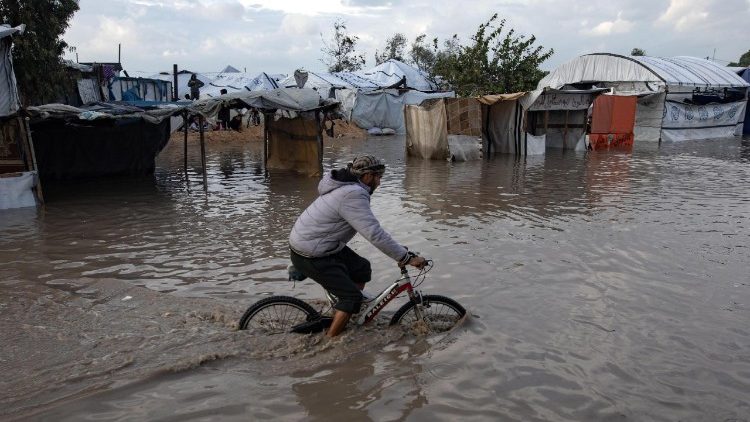
Aid workers say heavy rainfall is causing widespread suffering in Gaza.
By Nathan Morley
Flooding has washed away thousands of tents in Gaza, leaving many shelters unusable after two years of Israeli bombardment.
One man was killed when a residential building partially collapsed.
The UNDP has highlighted the urgent need for safe, durable shelters.
With support from South Korea, the agency has replaced more than 800 worn-out tents for displaced residents, but said the effort falls far short of demand.
Meanwhile, teams managing displacement sites are clearing drains and pumping floodwater.
Winterization programs are underway, with the U.N. distributing tents, blankets and other supplies.
Still, conditions remain dire.
Health workers confirmed the first hypothermia-related death this week — a two-week-old boy from Khan Younis.
While food supplies have improved with increased aid and commercial imports, protein remains scarce.
Humanitarian access continues to be restricted, with aid convoys facing logistical and security obstacles.
U.N. officials urged all parties to allow full, unimpeded entry of assistance.
Listen to Nathan Morley's report
Thank you for reading our article. You can keep up-to-date by subscribing to our daily newsletter. Just click here
Vatican Media’s headquarters holds a launch event for a new book by Chinese author Chiaretto Yan, entitled “My Chinese Dream: Dialogues and Encounters with Christianity”
By Guglielmo Gallone
“My Chinese dream is to be a bridge between Christianity and China: I hope that the Pope can visit my country, and that China can welcome the light of the Gospel.”
Those were the words of Chiaretto Yan, a Chinese member of the Focolare Movement, in an interview with Vatican Media.
He was speaking at the launch of his book Il mio sogno cinese: Dialoghi e incontri con il cristianesimo (“My Chinese Dream: Dialogues and Encounters with Christianity”), which was presented on Tuesday at the Vatican Media headquarters in Rome’s Palazzo Pio.
The universal desire for truth, goodness, and beauty
This dream, Yan explains, is rooted in the conviction that, for Chinese culture, Christianity is not a foreign element but a possible dialogue partner.
“In every human being there lives a universal desire for truth, goodness, beauty and love,” he said, “a deep longing that crosses cultures and traditions, and that in Christianity finds expression in a personal relationship with God.”
“On the one hand I am a Catholic Christian,” Yan continues, “and on the other I am Chinese. The Christian faith tells me that God comes toward us, that He became incarnate out of love for humanity. God’s initiative toward the human person is divine Revelation. Other cultures, as well as other religions, are also humanity’s effort to seek God. That is why I believe these two 'directions' meet; they are not in contradiction.”
Five paths forward
With this spirit, the author chose to focus on five areas of research that could bring Chinese culture and Christianity together: philosophy, ecology, politics, economics and cultural dialogue.
“These are all highly topical issues,” Yan observes, “and they are a shared challenge for all humanity. We have seen this in Pope Francis’ pontificate, in encyclicals such as Laudato Si’ and Fratelli Tutti, but we also see it in contemporary Chinese debate."
This convergence is also grounded in the Chinese tradition, Yan continues. “Confucius says: ‘We cannot know enough about this life, so I do not investigate the afterlife.’ Laozi says: ‘Those who know do not speak; those who speak do not know.’ These statements do not point to a rejection of transcendence, but rather to an attitude of humility: the afterlife is a mystery, and human beings do not possess it — they can only draw near to it. At heart, this is an attitude of openness that recognizes the limits of language and reason, and that finds a point of contact with Christianity."
While in the West dialectic has often been conceived as conflict, Yan explains, following philosophical schemes such as Hegel’s, "in Taoism it takes the form of harmony: yin and yang do not oppose each other in order to annihilate one another, but call to and complete one another.”
Within this logic, Yan sees the “dialectic of love” proper to Christianity, especially in the mystery of Christ on the cross, who empties himself, makes room, embraces emptiness in order to fulfill the Father’s will.
“In Chinese philosophical language as well,” Yan notes, “the relationship between being and non-being is not destructive, but generative: it is from this relationship that harmony is born. And it is here that dialogue becomes deeper, to the point where it becomes possible to speak.”
The book launch
Dialogue was at the heart of the book launch, which featured Professor Agostino Giovagnoli, professor of Contemporary History at the Catholic University of the Sacred Heart in Milan; Fr. Federico Lombardi, S.J., president of the Joseph Ratzinger–Benedict XVI Vatican Foundation; and Fr. Antonio Spadaro, S.J., undersecretary of the Dicastery for Culture and Education.
Moderating the discussion was Gianni Valente, director of the Vatican's Fides News Agency.
Thank you for reading our article. You can keep up-to-date by subscribing to our daily newsletter. Just click here
Pope Leo condemns antisemitism in phone call with Israeli President
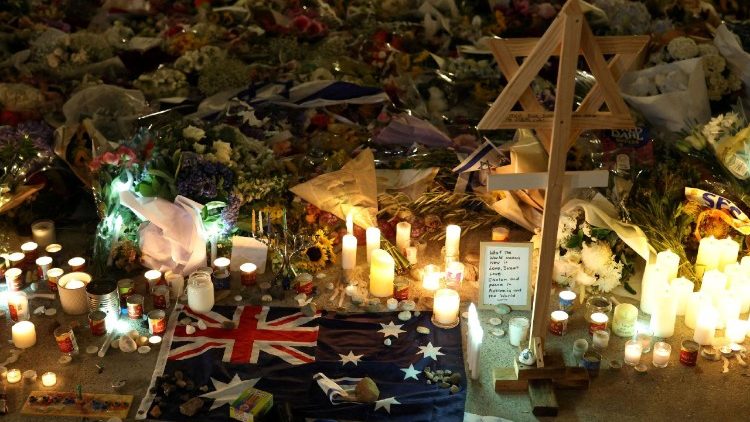
Pope Leo XIV receives a telephone call from Isaac Herzog, President of Israel, following the recent terrorist attack in Sydney, and reiterates the Catholic Church’s condemnation of all forms of antisemitism.
Vatican News
On Wednesday, December 17, Pope Leo XIV received a telephone call from Isaac Herzog, President of the State of Israel, as Christians prepare to celebrate Christmas and Jews mark the festival of Hanukkah.
According to the Holy See Press Office, the conversation came in light of the recent terrorist attack on the Jewish community in Sydney, Australia.
Pope Leo reiterated the "Catholic Church’s firm condemnation of all forms of antisemitism, which, throughout the world, continues to sow fear in Jewish communities and in society as a whole."
The Pope also renewed his appeal for "perseverance in the various ongoing peace processes in the region, and emphasized the urgency of intensifying and continuing efforts in the area of humanitarian aid."
On Sunday, December 14, two men targeted an event held at Bondi Beach during the Jewish celebration of Hanukkah, killing 15 people and injuring 25 more.
The next day, Pope Leo prayed for the victims of the terrorist attack, as he met with groups that donated the Vatican's Christmas tree and Nativity Scene.
“Enough with these forms of antisemitic violence!” Pope Leo said. “We must eliminate hatred from our hearts.”
The Pope also sent a telegram to express his condolences and invoke “the divine blessings of peace and strength upon all Australians.”
Thank you for reading our article. You can keep up-to-date by subscribing to our daily newsletter. Just click here
Thailand: Compassion in the villages of Chiang Mai
Among rice paddies and temples in northern Thailand, Idente Missionaries live alongside families in villages, transforming their shared life into a place of encounter between the Gospel and local traditions.
By Eleanna Guglielmi
“Do not fear our littleness: sometimes listening to someone with the heart is the most profound proclamation of the Gospel,” according to Yotsaya, a missionary, as she explains one of the key aspects of the Idente mission among the Thai villages of the Karen, Lahu, Akha, Hmong, and Lisu people.
Life here depends on daily jobs and an unpredictable agricultural system. Young people leave school early, and the elderly and children are the ones who are most vulnerable to pollution, flooding, and precariousness.
In the midst of all this fragility, the presence of Catholics, a small minority in a country with a Buddhist majority, takes the form of compassion, attention, and coexistence.
A young minority Church
The proclamation of the Gospel reached northern Thailand after World War II, becoming rooted among the mountain tribal people.
Today, Catholics are still a small minority, but the Church has chosen to be missionary. Relations with other religions are not limited to official encounters, but are also lived in villages and schools, where small agricultural, healthcare, and educational projects are shared spaces that are intertwined with the family lives of people with different faiths.
The Church participates in feasts, songs, and other local traditions, choosing not to replace but rather to insert herself as a friendly presence that safeguards and strengthens social cohesion.
“We celebrate in Thai, but people reply in their languages, and the hymns transmit a spirituality that needs no translation,” explains Identes Missionary Fr. Thinnakorn.
The liturgy and catechesis are often inculturated, using local languages with attention to tribal traditions.
Many of the faithful are members of the Karen, Lahu, Akha, Hmong, and Lisu tribes, who have a strong sense of community, which is fertile soil for Christian witness. The mission enjoys a different focus in the capital city.
“Many young people arrive on their own, without their family and without support networks,” according to Cristina. “Their primary need is someone who listens to them.”
Sitting beside her, Esterlicia adds, “Food parcels are not enough. Offering them the opportunity to study and grow is the way to restore trust.”
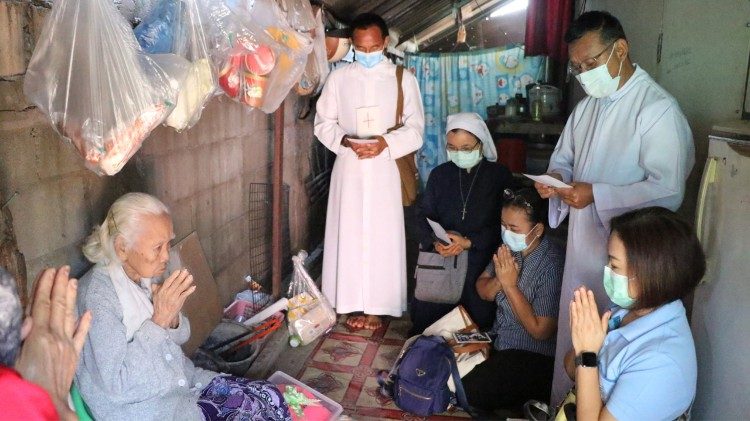
Missionaries visit a man who is ill, in his home
Lack of a future is the real misery
Yotsaya recounts the story of “a 14-year-old girl who wanted to continue studying, but who already knew she would have to drop out early to help her family.”
This situation, said Yotsaya, “made me understand that poverty does not just mean lack of money, but also lack of opportunity and a future denied.”
This is the real misery: to have no prospects. Children in the villages share their sweets, and neighbours support one another through challenges. Yet, precariousness remains, including occasional work, forced migrations, the young forced to drop out of school, and the elderly and children suffering from the effects of pollution and natural disasters.
Poverty here has the concrete face of impossible choices and suspended lives.
Wounds that become comfort
“We met an elderly couple, who had lost both their children,” recalls Esterlicia. “At first, they did not want to see anyone. Gradually, visit after visit, they began to smile.”
With similar simple gestures, missionaries draw near to people, listen, and offer loyal friendship that restores dignity and courage.
Religious communities from the Diocese of Chiang Mai visit the elderly in a village
A compassionate heart
The mission in Chiang Mai is focused on relationships. Pastoral activity is intertwined with social and charitable commitment in schools, hospitals, and healthcare centres, as well as agricultural projects and development programs for hill tribes.
Special care is devoted to the poor, migrants, minors, and vulnerable people.
Interreligious dialogue is a daily and natural occurrence among Catholics, Buddhist monks, lay Muslims, and animist communities. This dialogue results in shared initiatives in favor of the environment, peace, and education.
“Living among these challenges made us understand that consecration means sharing practical life, not only by teaching, but also being near with a compassionate heart,” explain Thinnakorn and Thannoungsak.
The power of simplicity
Twenty-three years after their arrival in Chiang Mai, the Identes missionaries continue to offer their silent and steadfast presence in simplicity.
“Even small things have great value because they bear witness to God, who is always near to the little ones,” highlights Thinnakorn. “I have learned that having a meek and compassionate heart is a path to understanding God’s love and to living as brothers and sisters, [children] of the One God.”
Young people share a meal in Chiang Mai
Thank you for reading our article. You can keep up-to-date by subscribing to our daily newsletter. Just click here
Pope on Advent: Prepare for Christ’s coming, don’t get lost in frenetic activity
In his greetings to the faithful from the different language groups during the Wednesday General Audience, Pope Leo XIV underlines the importance of Advent as a time of preparation, prayer, and reflection so that we may welcome the birth of Christ at Christmas.
By Isabella H. de Carvalho
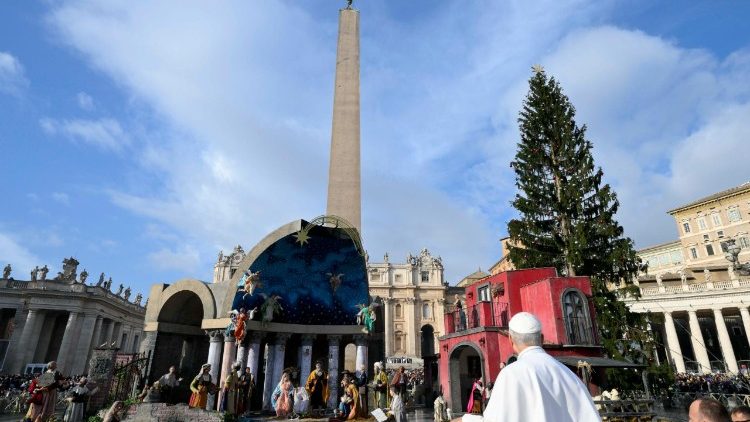
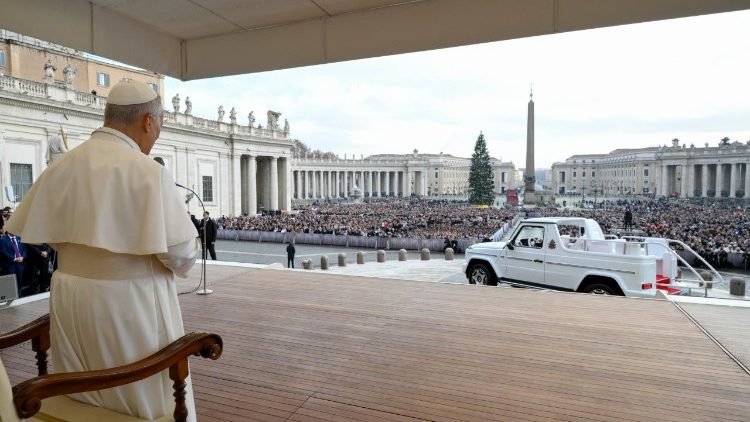
As the Vatican Christmas tree and Nativity Scene adorned a St. Peter’s Square filled with faithful, Pope Leo XIV highlighted the importance of Advent as a time of preparation to welcome the birth of Christ.
He offered the encouragement in his various greetings to pilgrims from different language groups during the Wednesday General Audience on December 17.
“I pray that each of you, and your families, may experience a blessed Advent in preparation for the coming of the newborn Jesus, Son of God and Savior of the world,” Pope Leo said to the English-speaking faithful.
Pope Leo during the General Audience (@Vatican Media)
Importance of nativity scenes
“Christmas is just a few days away, and I imagine that in your homes the Nativity Scene, an evocative representation of the Mystery of the Nativity of Christ, is being completed or has already been completed,” he reflected in his greeting to the Italian faithful.
On Monday, December 15, the Vatican unveiled its Nativity Scenes in St. Peter’s Square and the Paul VI Audience Hall.
“I hope that such an important element, not only of our faith but also of Christian culture and art, will continue to be part of Christmas to remember Jesus, who, by becoming man, came ‘to dwell among us’.”
Don’t get caught up in frenetic activity
As Christmas is only a week away, he encouraged the faithful to live this celebration deeply and not get distracted by other aspects, as he greeted French-speakers.
“Let us be careful not to get caught up in frenetic activity in preparing for the feast, which would lead us to experience it in a superficial way and leave room for disappointment,” he explained. “Instead, let us take the time to make our hearts attentive and vigilant as we await Jesus, so that His loving presence may become the treasure of our lives and hearts forever.”
In his greetings to German pilgrims, he underlined that Advent “invites us to prepare for Christmas by welcoming Jesus without reservation.”
“He is our hope. Therefore, let us joyfully await the feast of his birth and pray together with confidence: ‘Come, Lord Jesus’,” the Pope said.
The Pope greets the faithful in St. Peter's Square (@Vatican Media)
A time for reflection and prayer
In his greetings to Polish speakers, he called for the last days of Advent to be a time of reflection and prayer and to prepare for the coming of Christ through the Sacrament of Confession or spiritual retreats.
In greeting the Portuguese-speaking faithful, he emphasized how we are now in the period of the Christmas Novena, which began on Tuesday and is “rich in traditions” in some of their communities.
He added that this devotion can become “for everyone a renewed opportunity to lighten the heart, preparing it for the imminent birth of the Son of God. May Our Lady of Hope accompany you in this spiritual commitment and always protect you and your families.”
“Christians are called to open their hearts to the love of God and neighbor, so that they may be filled with true peace and joy,” the Pope insisted in his greeting to the Arabic-speaking pilgrims.
The Pope in St. Peter's Square during the General Audience (@Vatican Media)
Upcoming General Audiences
On Wednesday, December 24, there will be no General Audience, as it is Christmas Eve.
There will be a Jubilee Audience on Saturday, December 20, and the next General Audience will be held on December 31, the last day of the year.
The last time a General Audience took place on New Year's Eve was 50 years ago in 1975, which was held by Pope St. Paul VI.
Thank you for reading our article. You can keep up-to-date by subscribing to our daily newsletter. Just click here
Pope at Audience: Unjust investments come at ‘bloody price of millions of human lives’
In his catechesis at the weekly General Audience, Pope Leo XIV explains that our hearts can only find true rest in God and not in the many daily “activities that do not always leave us satisfied.”
By Kielce Gussie
During his Wednesday General Audience in St. Peter's Square, Pope Leo XIV reflected on the universal feeling that we all have to be constantly on-the-go, which “drives us to do, to act.”
He highlighted how speed is often required to reach the ideal goals in almost any field. But, rather than focus on worldly demands, he turned the focus to Jesus’ Resurrection and how this can affect our daily life.
When all of us participate in Christ's victory over death, the question is: Will we find rest? The Pope explained that our faith tells us that we will. Yet, it will not be an inactive rest. Rather, we will live in peace and joy. Pope Leo asked: “So, should we just wait, or can this change us right now?”
“At the bloody price of millions of human lives”
Each day, we find ourselves completely absorbed in activities that do not fulfill us, but which deal with practical, concrete issues.
Our daily lives are filled with choices, problems, difficulties, and responsibilities. This was also the case for Jesus, yet His focus remained on “giving Himself to the end.”
Pope Leo warned against thinking that doing so many things gives fulfillment. Instead, it “becomes a vortex that overwhelms us, takes away our serenity, and prevents us from living to the fullest what is truly important in our lives.”
The Pope signs a baseball in the popemobile (@VATICAN MEDIA)
When we are tired and dissatisfied, it can feel as though we spend so much of our time on a million practical things that do not lead us to the final goal of our existence. Even at the end of days full of events and activities, we can feel empty. Why, the Pope asked, “Because we are not machines, we have a ‘heart’; indeed, we can say that we are a heart.”
The heart, the Holy Father explained, “is the symbol of all our humanity, the sum of our thoughts, feelings, and desires, the invisible centre of ourselves.” The Gospel of Matthew invites us to reflect on the heart as the place where we keep all our treasure.
For this reason, it is essential that we do not store our treasure in earthly, temporal things. Our treasure should not be found in financial investments, “which today more than ever before are out of control and unjustly concentrated at the bloody price of millions of human lives and the devastation of God’s creation.”
The Pope urged everyone to look within themselves to see where their treasure and hearts lie because with the sometimes-overwhelming amounts of commitments, we face a growing risk of dispersion, despair, and meaninglessness.
Quieting our restless hearts
Yet, if we shift our interpretation of life and put it through the lens of Easter, we can find meaning; we gain “access to the essence of the human person, to our heart: cor inquietum.” This is the “restless heart” which St. Augustine is so famous for speaking about in his work, Confessions.
St. Augustine of Hippo wrote his "Confession" at the end of the 4th century (VALENCIA, SPAIN - FEBRUAR 14, 2022: The baroque painting of St. Augustine in the Cathedral after original by Claudio Coello)
This sense of restlessness shows that our hearts do not move by chance, “in a disordered way, without a purpose or a destination, but are oriented towards their ultimate destination, the ‘return home’.” Our heart’s true treasure is found in the God who loves, and we can encounter this in loving our neighbors.
Seeing our brothers and sisters requires us to slow down and look them in the eyes; sometimes, it requires a change of plans or a new direction.
As Pope Leo noted, the secret of the heart’s movement is “returning to the source of its being, delighting in the joy that never fails, that never disappoints.”
It is impossible to live without meaning, beyond that which goes away. “The human heart cannot live without hope,” the Pope stressed, “without knowing that it is made for fullness, not for want.”
Jesus—through His Incarnation, Passion, Death, and Resurrection—paved the road to this hope for us. If we enter “into the dynamism of the love for which it was created,” our restless hearts will not be disappointed. The destination is sure, life has won, and through Christ, life will continue to win “in every death of daily life.”
Thank you for reading our article. You can keep up-to-date by subscribing to our daily newsletter. Just click here
Pope Leo to the sick: May the joy of Christmas accompany you all
At a “small, slightly more personal” encounter inside the Paul VI Hall, Pope Leo XIV greets people with various illnesses and disabilities, offering a special blessing and the wish that “the joy of the Christmas season may accompany” them, their families, and their loved ones.
By Christopher Wells
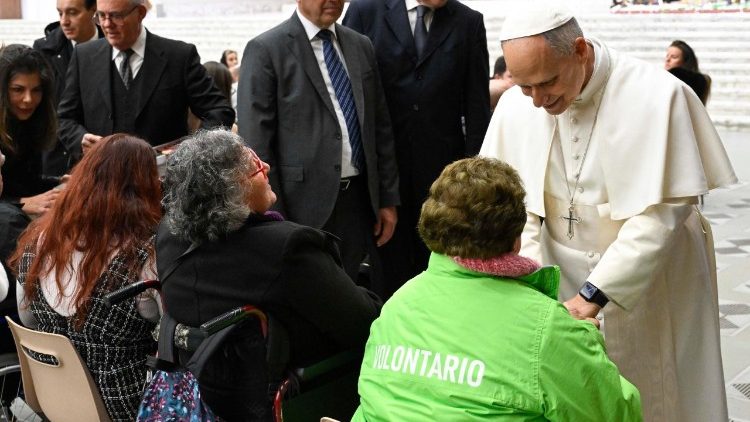
Pope Leo met with people with various illnesses and disabilities in the Paul VI Hall on Wednesday, ahead of the weekly General Audience in St Peter’s Square.
While a section close to the Pope is normally reserved at the Audience for those who are sick, the Holy Father explained that this week they were offered a smaller, “slightly more personal meeting” due to the possibility of inclement weather.
“We wanted to protect you a little from the elements: from the cold especially,” Pope Leo said. “It’s not raining,” he noted, “but perhaps this way you’ll be a little more comfortable.”
While offering those present the opportunity to go outside for the Audience, the Pope said he wanted to take advantage of the encounter to greet them, bless them, and offer a special wish for the holidays, asking the Lord “that the joy of this holiday season may accompany all of you, your families, and your loved ones.”
He added, “May you always be in the hands of the Lord, with confidence, with this love that only God can give us.”
The Holy Father proceeded to greet personally those present, before moving to the Square for the General Audience.
Thank you for reading our article. You can keep up-to-date by subscribing to our daily newsletter. Just click here
Pope to school children: At Christmas, build peace and unity
Pope Leo XIV joins children at a school Christmas concert in Castel Gandolfo, and invites those present to communicate to all the gift of love at Christmas.
By Tiziana Campisi
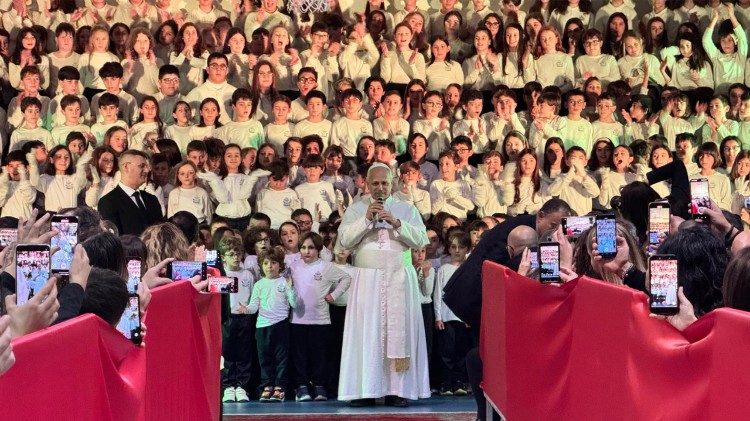
A special visit marked the eleventh edition of the Christmas concert InCanto, performed by the pupils of the Pontifical Paul VI School of Castel Gandolfo. Among those attending this afternoon was Pope Leo XIV. After leaving the nearby Villa Barberini, where he regularly stays on Tuesdays, the Pope visited the school and then joined the pupils and their families in the gymnasium for the musical performance.
The concert was an occasion for the children to wish everyone a Merry Christmas, and to underline that true richness is not measured by what one receives, but by the peace one can generate within oneself and in relationship with others.
Christmas awakens joy and peace
The pupils, all dressed in jeans and white shirts, took their places on the tiered stage. Smiling and visibly moved, they performed a selection of Christmas carols. The melodies of Adeste fideles, Joy to the World, Noël Noël and Astro del ciel filled the festively decorated gymnasium, crowded with parents, teachers, and school staff. The Bishop of Albano, Monsignor Vincenzo Viva, the President of the Administration of the Patrimony of the Apostolic See, Monsignor Giordano Piccinotti, and the Pope were seated in the front row.
“At the end of the concert,” Pope Leo said, “It was beautiful to listen to Christmas songs in Italian, Latin, English and Spanish.” Hearing children sing in different languages, he said, helps everyone to understand that Christmas awakens joy and peace in everyone's heart. The Pope also expressed his gratitude for the invitation, adding, with a smile, that it had arrived “mysteriously” and that he was happy to have accepted it.
An invitation to do more for peace
Reflecting on one of the songs performed, with lyrics referring to “angels who bring love,” the Pope noted that the children themselves had brought love through their music. He recalled the words of Saint Augustine, who said that “the one who loves sings,” because love enables the heart to grasp what truly matters.
“God wished to communicate to all of us the gift of love: this is what Christmas is,” Pope Leo said, emphasising that God draws close to humanity, especially to the smallest and most vulnerable. He expressed the hope that this spirit, celebrated at Christmas, might be lived out not only in these days but throughout the year. Quoting the refrain of another song, the Pope added, “For us this is a great invitation: to do more to proclaim peace, love and unity in the world.”
Seeing God in the least among us
At the conclusion, Pope Leo offered his blessing to the children and their families, encouraging them to pray together and to open their hearts to recognise God’s presence, especially in the smallest ones.
The Pope was greeted with applause and joyful cheers. He received a tennis racket and the school uniform as gifts, and posed for a commemorative photograph with the pupils before leaving.
The Pontifical Paul VI School
The Pontifical Paul VI School of Castel Gandolfo is a Catholic primary school located about 700 metres from Villa Barberini. Pope Paul VI promoted its construction as a gift to the local community, and it was inaugurated by the Pope himself on 12 September 1968. On that occasion, he highlighted the importance of Catholic education for children and young people.
Today, the school welcomes around 300 pupils and offers an educational programme inspired by Catholic principles, enriched by extracurricular activities including sports, music, foreign languages, civic education and food education.
Thank you for reading our article. You can keep up-to-date by subscribing to our daily newsletter. Just click here
Pope thanks UISG for bearing testimony to Gospel at frontiers of mission
In a letter sent on the occasion of the 60th anniversary of the founding of the International Union of Superiors General, Pope Leo XIV urges women religious to be “pilgrims and missionary disciples of hope,” to heal the wounds of those they encounter.
By Benedetta Capelli
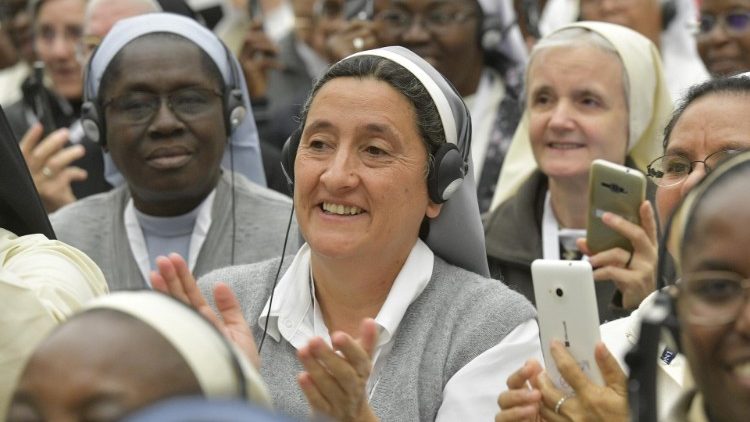
Recalling “the vision of Saint Paul VI,” who promoted the renewal of consecrated life in the modern world in the wake of the Second Vatican Council, Pope Leo XIV expresses his gratitude to all members of the International Union of the Superiors General (UISG) for carrying out their mission “with fidelity and courage”.
In a letter addressed to Sister Oonah O’Shea, UISG President, on the occasion of the 60th anniversary of the union’s foundation, which took place on 8 December 1965, the Pope says,“I join you in gratitude for the many ways in which the UISG has carried forward this mission.”
He recalled how over its sixty years, the UISG has fostered a space for dialogue among Superiors from all six continents, sharing “the richness of their charisms” and the gifts of the Holy Spirit “for the good of the Church and of the world.”
Missionary disciples of hope
The Pope notes that the present time is marked “by rapid change and many urgent needs.” He says the commitment of women religious in cooperation and mission at the frontiers becomes “a powerful testimony to the Gospel.”
The fact “that this anniversary coincides with the Jubilee Year of Hope,” Leo XIV adds, “is a particular grace.”
Hence, his wish that in this “sacred time” may renew in each member of the union, the “call to be pilgrims and missionary disciples of hope - women who, rooted in consecration and guided by the Spirit, help to awaken trust, heal wounds, and accompany God’s people with compassion and joyful perseverance.”
The Pope concludes by entrusting them to Mary, “Mother of the Church and model of faithful discipleship.”
A future yet to be written
A statement issued by Sister Oonah O’Shea says, “Sixty years ago, the UISG was founded to unite, listen and build communion. Today we celebrate a history that is constantly evolving, looking towards the future and open to new horizons.”
She announced that on the occasion of its 60th anniversary, the UISGpresents a new documentary entitled “Consecrated Life, a Hope that Transforms”, which traces the path of a worldwide network of women's religious congregations and shows the contemporary face of consecrated life through stories, cultures and continents.
Thank you for reading our article. You can keep up-to-date by subscribing to our daily newsletter. Just click here
Parolin: Invite Christ to be born every day in your heart
Holy See Secretary of State Cardinal Parolin presides over at Mass in a hospital chapel in Rome, and visits the oncology ward, bringing Christmas greetings to the patients.
By Edoardo Giribaldi
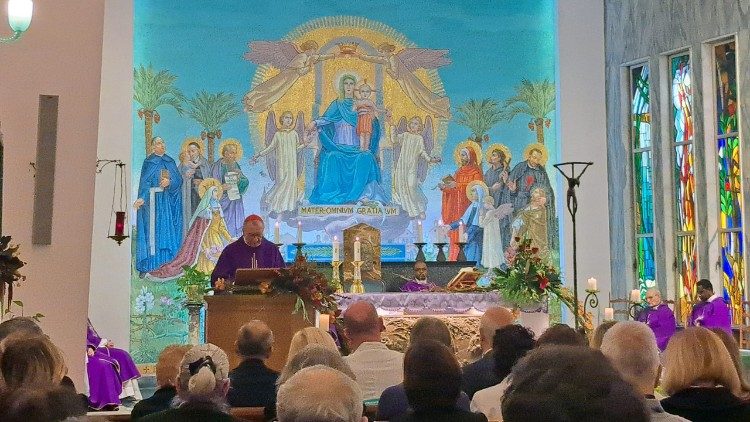
Cardinal Pietro Parolin presided over Mass this morning, December 16, in the chapel at Rome’s Dermopathic Institute of the Immaculate Conception.
In his homily, the Holy See Secretary of State said that the days leading up to Christmas, “charged with hope and longing,” are sustained by the liturgy, which takes the entire ecclesial community by the hand and gradually leads it “to the mystery of the birth of the Savior”.
Advent is therefore a time of waiting, he said, also oriented toward Jesus’ second coming.
In this regard, the cardinal recalled that Christ’s comings are threefold: the first took place in Bethlehem more than two thousand years ago, the second will come at the end of time, and the third takes root each day in the hearts of the faithful and of the Christian community “through the Word and the sacraments.”
Cardinal Parolin visits patients in the oncology ward
“Powerlessness” in the face of illness
Cardinal Parolin then reflected on today’s Gospel passage from Matthew, in which Jesus tells the parable of the two sons: the first initially refuses to go and work in the vineyard but later repents and goes; the second promises to do so but does not keep his word.
It is the first, of course, who carries out the father’s will.
The Lord, Parolin explained, seeks “sincere hearts” for his mission—a mission that is lived out within the walls of the Institute, one marked by a daily confrontation with a sense of “powerlessness” in the face of illness.
Visit to the patients
“If Christ is not born every day in your heart,” Cardinal Parolin said, “His birth in Bethlehem is of no value.”
He thus invited his listeners to make the Institute a true “manger”.
At the conclusion of Mass, the cardinal placed a figure of the Baby Jesus beneath the Christmas tree set up in the entrance of the Institute. He then went to the oncology ward to convey his Christmas greetings to the patients.
Thank you for reading our article. You can keep up-to-date by subscribing to our daily newsletter. Just click here