Venezuela: Strong explosions in Caracas, President Maduro captured
Vatican News |
3 January 2026
The capital of the Latin American country has been hit by a series of attacks that Venezuelan authorities have described as a “U.S. aggression.” US President Trump says President Nicolas Maduro has been captured together with his wife and flown out of the country.
By Guglielmo Gallone
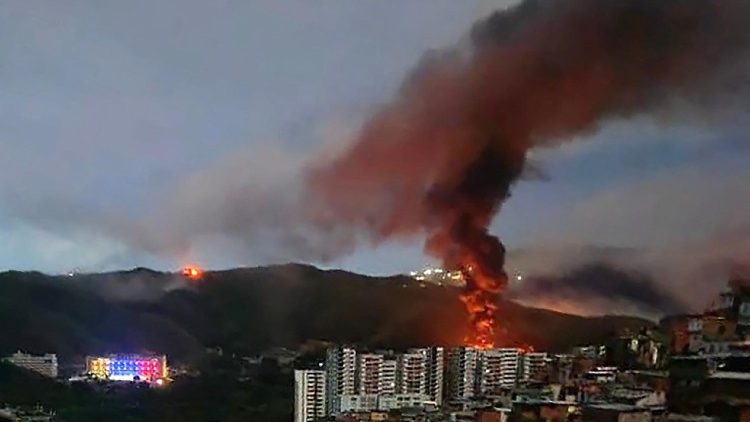
A series of explosions struck Venezuela’s capital Caracas overnight, along with low-flying aircraft being reported in surveiling the area around 2:00 a.m. local time in several neighborhoods of the city. U.S. President Donald Trump confirmed that “the United States of America has successfully carried out a large scale strike against Venezuela and its leader, President Nicolás Maduro, who has been, along with his wife, capture and flown out of the Country.” He added that the operation was conducted in conjunction with U.S. Law Enforcement and announced a press conference to be held in the coming hours at Mar-a-Lago.
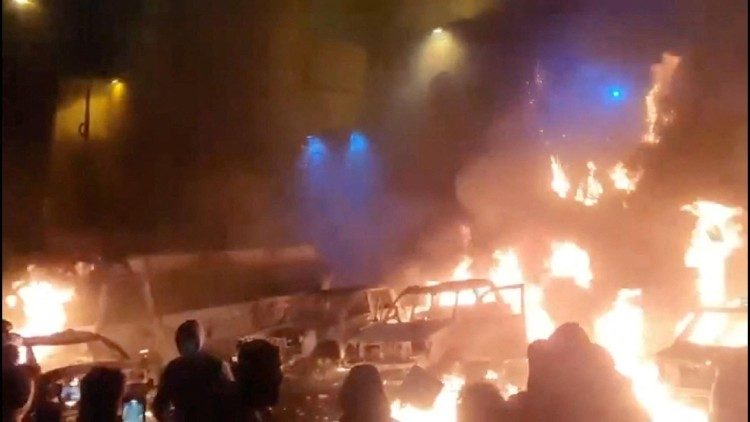
According to journalists present at the scene, at least seven detonations shook the metropolitan area, prompting many residents to go out into the streets. Fires and columns of smoke were observed in several parts of the capital, and power outages occurred in some areas of Caracas. The attacks reportedly hit military installations and strategic infrastructure, including the Generalísimo Francisco de Miranda air base in La Carlota, the Fuerte Tiuna military complex, the Mamo Military Academy in La Guaira, the Higuerote air base and airport, as well as areas such as Catia and the 23 de Enero neighborhood. Venezuelan President Nicolás Maduro declared a nationwide state of emergency and called for the mobilization of the population, denouncing what he described as a “very serious military aggression.”
In a series of official statements, the Caracas government attributed the attacks to the United States, speaking of a “serious military aggression” and a “blatant violation of the United Nations Charter, in particular the principles of sovereignty and the prohibition of the use of force.” The Maduro government accused Washington of seeking to seize the country’s strategic resources, starting with oil and minerals, and of attempting regime change through what it described as a “colonial war” carried out with the support of “local fascist oligarchies.” According to Caracas, the attacks also targeted residential areas housing senior military leadership and some of the main structures of the Venezuelan armed forces.
Thank you for reading our article. You can keep up-to-date by subscribing to our daily newsletter. Just click here
Pope calls for patience and dialogue in Iran and Syria
At the end of the Sunday Angelus, Pope Leo prays for peace in Iran, where protests continue, and Syria, where the army is battling Kurdish forces in the city of Aleppo. He also condemns the recent Russian strikes on Ukrainian civilians.
By Vatican News
After the Angelus prayer on Sunday 11 January, Pope Leo called for peace and dialogue, speaking in particular of two countries in the Middle East, Iran and Syria, where he said "persistent tensions are causing the deaths of many people”.
Since late December, Iran has been the scene of new demonstrations against the regime, which have spread to many of the country’s provinces and have been repressed by security forces. In Syria, there has been widespread fighting in recent days between the army and Kurdish forces in the northern city of Aleppo.
Speaking of these two countries, the Pope said that he hoped and prayed “that dialogue and peace will be cultivated with patience, in pursuit of the common good of the whole society."
Pope Leo also recalled the plight of the Ukrainian people, who are suffering under Russian bombardment. He lamented that these attacks are “particularly serious, targeting mainly energy infrastructure, while the cold intensifies, hitting the civilian population hard”.
“I pray for those who are suffering and I renew my call for an end to violence and for intensified efforts to achieve peace,” the Pope said.
Thank you for reading our article. You can keep up-to-date by subscribing to our daily newsletter. Just click here
Bethany Beyond the Jordan, the Place of Jesus’ Baptism
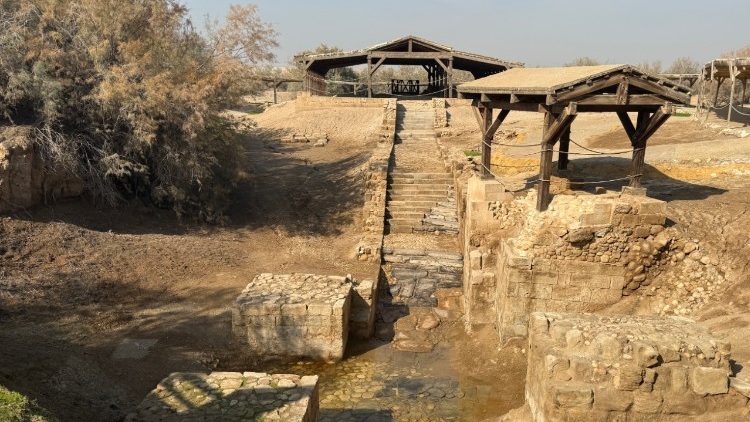
Today the Church celebrates the Feast of the Baptism of the Lord. At Al-Maghtas, in Jordan, archaeological excavations have uncovered the remains of churches, chapels, hermits’ caves, and a baptistery––places of worship tied to Jesus’ Baptism. In 2015 this area was inscribed on the UNESCO World Heritage List. Three Popes have made pilgrimages there: John Paul II, Benedict XVI, and Francis.
By Fr Pawel Rytel-Andrianik – Al-Maghtas
The Gospel of John says that John the Baptist baptized beyond the Jordan: “This took place in Bethany beyond the Jordan, where John was baptizing” (Jn 1:28). It also says: “He went away again across the Jordan to the place where John at first baptized, and there he remained” (Jn 10:40).
“Bethany beyond the Jordan” is not the Bethany near the Mount of Olives, which Jesus often visited, but another Bethany. Origen (3rd century), John Chrysostom (4th century) and the Christians of that time emphasized that “Bethany beyond the Jordan” was then known as Bethabara. This name appears in some manuscripts of the Gospel of John that refer precisely to “Bethany beyond the Jordan” (Jn 1:28). It also appears on the sixth-century Madaba map, which identifies in this way the place of Jesus’ baptism. Bethabara is also mentioned in the Talmud. Today this place is known as Al-Maghtas, which in Arabic means “baptism” or “immersion”.
Archaeological Evidence
Until the beginning of the 4th century, Christianity—often persecuted in the Roman Empire—was not able to build official places of worship. Nevertheless, the Christians of the first centuries passed down from generation to generation the memory of the sites connected with the life of Jesus.
Between the end of the 5th and the beginning of the 6th century, the Byzantine emperor Anastasius I Dicorus had the first church dedicated to John the Baptist built at the site now known as Al-Maghtas. This church was destroyed by floods and earthquakes. The structure was rebuilt several times, but probably by the 7th–8th century only ruins remained.
One pilgrim at the time, known as Theodosius (around the year 530), wrote about the church: “Five miles north of the Dead Sea, at the place where the Lord was baptized, there stands a solitary column, on which an iron cross is fixed; there is also the church of Saint John the Baptist, built by Emperor Anastasius. The church is very high, built over large chambers because of the flooding of the River Jordan”.
At this site, the Basilica of the Holy Trinity was also built. The name of the church recalls the fact that during Jesus’ baptism the Trinity was revealed: God the Father speaking from heaven and the Holy Spirit in the form of a dove above Jesus. Archaeological excavations indicate that it was a large church, at least 27 meters long and more than 15 meters wide, although today only a few ruins remain.
In addition to these churches, archaeologists have identified a lower basilica, hermits’ caves, chapels, mosaics, marble floors, and a huge cross-shaped baptistery, all built close to one another at the site now known as “Bethany beyond the Jordan” – Al-Maghtas.
Near Al-Maghtas, excavations have also uncovered the hill of Tell al-Kharrar, known as Elijah’s Hill (Jabal Mar Elias), linked to the prophet Elijah. In the Byzantine period, probably in the 5th century, a monastery was erected there in his honor.
UNESCO: Outstanding value for humanity
In 2015, the area of “Bethany beyond the Jordan” (Al-Maghtas), including Tell al-Kharrar, was added to the UNESCO World Heritage List. The official website says: “‘Bethany beyond the Jordan’ is of immense religious significance to the majority of denominations of Christian faith, who have accepted this site as the location where Jesus of Nazareth was baptised by John the Baptist. This reference encouraged generations of monks, hermits, pilgrims and priests to reside in and visit the site, and to leave behind testimonies of their devotion and religious activities, dating to between the 4th and the 15th century CE”.
The Popes at ‘Bethany Beyond the Jordan’
The first Pope to visit Al-Maghtas was John Paul II during the Jubilee of the Year 2000. Pope Benedict XVI visited the site in 2009 and inaugurated the construction of the church commemorating the Jesus’ baptism in the Jordan. In 2014, Pope Francis visited the site and met Syrian and Iraqi refugees, sick children, and people with disabilities who had found refuge in Jordan.
The new Church of the Baptism of the Lord was solemnly consecrated in January 2025. Representing Pope Francis, the Secretary of State of the Holy See, Cardinal Pietro Parolin, presided over the ceremony. It is currently the largest Catholic church in Jordan, and the area also includes churches of other Christian denominations.
Thank you for reading our article. You can keep up-to-date by subscribing to our daily newsletter. Just click here
Angelus: “God does not look at the world from afar”
At the Sunday Angelus, Pope Leo encourages Christians to reflect on the gift of their baptism, and to “bear witness to it with joy and consistency.”
By Olivier Bonnel
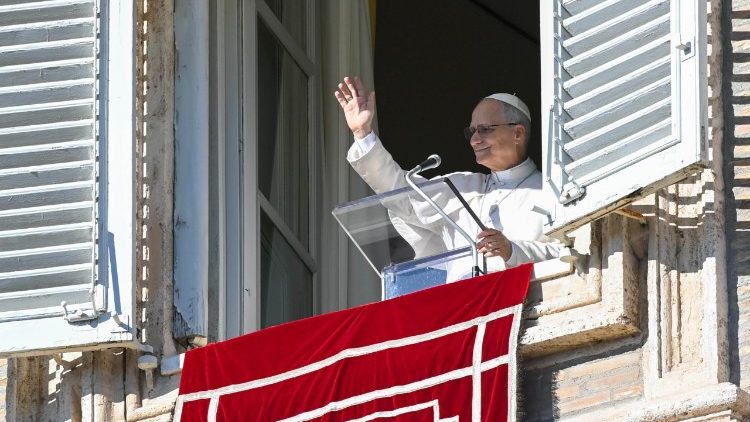
Under a bright winter sun, Pope Leo greeted the thousands of faithful gathered in St Peter’s Square on Sunday to celebrate the Feast of the Baptism of the Lord.
Observed on the Sunday following Epiphany, the feast marks the conclusion of the Christmas season and ushers the Church into Ordinary Time and the beginning of a new liturgical year.
This is a time, the Pope said in his address from the window of the Apostolic Palace, that “invites us to follow the Lord together, to listen to his word and to imitate his gestures of love toward our neighbour.”
Jesus’ baptism in the waters of the Jordan, the Pope continued, is an invitation to each of us to renew the promises of the sacrament, “which makes us Christians, frees us from sin and transforms us into children of God through the power of his life-giving Spirit.”
Commenting on the Gospel of Matthew, Pope Leo explained that, in this event, “the whole Godhead is made present in history: just as the Son descends into the waters of the Jordan, so the Holy Spirit descends upon him and, through him, is given to us as a force of salvation.”
Baptism brings each of us into the Church
“God does not look at the world from afar, without touching our lives, our wounds and our hopes,” the Bishop of Rome continued. “He comes among us with the wisdom of his Word made flesh, drawing us into a surprising plan of love for all humanity.”
To the great astonishment of John the Baptist, the Lord himself chooses to be baptized “like all sinners, in order to reveal the infinite mercy of God.”
The sacrament of baptism, Pope Leo said, introduces each of us into the life of the Church, “the People of God, made up of men and women of every nation and culture, reborn by his Spirit.”
The Pope encouraged the faithful to remember “this great gift we have received,” committing themselves “to bear witness to it with joy and authenticity.” He also recalled the service earlier that morning in the Sistine Chapel, during which he baptized twenty newborns, now “our new brothers and sisters in the faith.”
“This first of the sacraments is a sacred sign that accompanies us forever. In moments of darkness, Baptism is light; in life’s conflicts, it is reconciliation; at the hour of death, it is the gateway to heaven.”
Thank you for reading our article. You can keep up-to-date by subscribing to our daily newsletter. Just click here
What is the Angelus
The Angelus is a special prayer recited by Catholics three times a day, at 6am, noon, and 6pm and is accompanied by the ringing of the Angelus bell. The name comes from the Latin word for Angel and the prayer itself reminds us of how Jesus Christ assumed our human nature through the Mystery of the Incarnation. The Pope recites the Angelus prayer in St Peter’s Square every Sunday at midday. He also gives a brief reflection on the Gospel of the day and often comments on some issue of international concern. The Pope’s words are broadcast all over the world on radio and television and widely shared on social media. From Easter to Pentecost the Regina Coeli is prayed instead of the Angelus. This prayer commemorates the Resurrection of Jesus Christ and, like the Angelus, concludes with the recitation of the Gloria three times.
Angelus Dómini nuntiávit Mariæ. Et concépit de Spíritu Sancto. Ave Maria...
Ecce ancílla Dómini. Fiat mihi secúndum verbum tuum. Ave Maria...
Et Verbum caro factum est. Et habitávit in nobis. Ave Maria...
Ora pro nobis, sancta Dei génetrix. Ut digni efficiámur promissiónibus Christi.
Orémus. Grátiam tuam, quǽsumus, Dómine, méntibus nostris infunde; ut qui, Ángelo nuntiánte, Christi Fílii tui incarnatiónem cognóvimus, per passiónem eius et crucem, ad resurrectiónis glóriam perducámur. Per eúndem Christum Dóminum nostrum.
Amen.
Gloria Patri... (ter) Requiem aeternam...
Benedictio Apostolica seu Papalis
Dominus vobiscum.Et cum spiritu tuo. Sit nomen Benedicat vos omnipotens Deus, Pa ter, et Fi lius, et Spiritus Sanctus.
Amen.
The Angelus Prayer
The Angel of the Lord declared unto Mary. And she conceived of the Holy Spirit. Hail Mary, etc...
Behold the handmaid of the Lord. Be it done unto me according to Your Word. Hail Mary, etc...
And the Word was made Flesh. And dwelt among us. Hail Mary, etc...
Pray for us, O Holy Mother of God. That we may be made worthy of the promises of Christ.
Let us pray: Pour forth, we beseech You, O Lord, Your Grace into our hearts; that as we have known the incarnation of Christ, Your Son by the message of an angel, so by His Passion and Cross we may be brought to the glory of His Resurrection. Through the same Christ, Our Lord.
Amen.
Glory be, etc… (3 times) Eternal rest…
Apostolic Blessing
The Lord be with you. And with your spirit. Blessed be the name of the Lord.
Now and forever.
Our help is in the name of the Lord. Who has made Heaven and Earth. May Almighty God bless you. In the name of the Father, and of the Son, and of the Holy Spirit.
Pope baptizes 20 children: Now they have the meaning of life
Continuing a tradition begun in 1981 by Pope John Paul II, Pope Leo presided over the baptism of 20 children of Vatican employees in the Sistine Chapel.
By Kielce Gussie
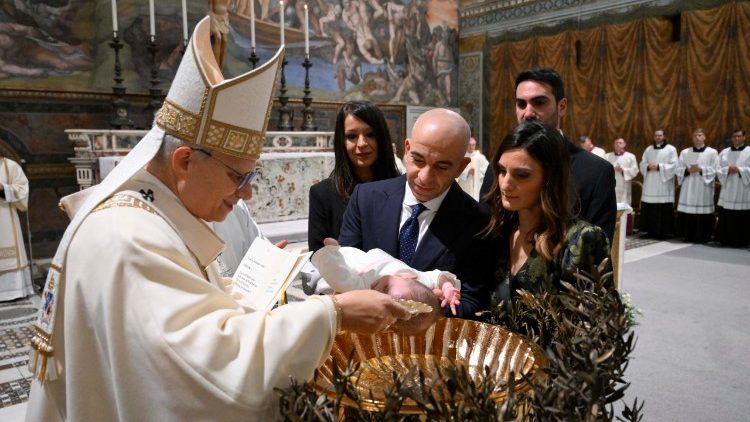
Carrying on a 45-year-old tradition, Pope Leo XIV baptized 20 children of Vatican employees in the Sistine Chapel. Following in the footsteps of his predecessors, the administration of the Sacrament took place during a Mass on the Feast of the Baptism of the Lord.
A new sign of forgiveness
In his homily, the Pope reflected on God entering history by coming down to earth to “meet each of us with an open and humble heart.” He wants to meet our gaze and reveal the Word of salvation to us, that is Jesus Christ.
By taking on human flesh, the Holy Father argued, “the Son of God offers to all a surprising possibility, inaugurating a new and unexpected time, even for the prophets.” John the Baptist recognizes this immediately and asks: “I need to be baptized by You, and You come to me?”
In this way, Jesus puts Himself in a place we would not imagine: “He is the Holy One among sinners, who desires to dwell among us without keeping distance, indeed, assuming fully all that is human.”
Pope in the Sistine Chapel for Mass on the Baptism of the Lord (@Vatican Media)
Jesus explained He is to be baptized by John to “fulfill all righteousness”. But Pope Leo begs the question: what is righteousness? We are made righteous through Christ who is baptized in the Jordan, making a “new sign of death and resurrection, of forgiveness and communion.”
“With God, life finds salvation”
This sacrament is the same sign these 20 children received because, as the Pope explained, “God loves them, they become Christians, our brothers and sisters.” Through their baptism, these children are made new.
“Just as they received life from you, their parents, so now they receive the meaning with which to live it: faith”, the Holy Father noted. He further stressed that when we know something is essential, we seek to give it to the people we love. For example, clothes and food for children.
Yet, even greater than food or clothes—which are necessary for life—faith is even more essential. “For with God, life finds salvation”, Pope Leo said, and God’s love for his children is made visible and tangible through parents, who ask for faith for their children.
The Pope baptizes one of the children in the Sistine Chapel (@Vatican Media)
In the future, he highlighted, the day will come when the children “will be heavy to hold in your arms; and the day will also come when they will be the ones to support you.” At this time, the Pope encouraged the families, offering his prayers that the Baptism that unites us will give families strength and perseverance.
The sacramental gestures of Baptism are a testament to this. The holy water symbolizes being washed in the Spirit and purified of sin; the white clothing is the new garment God gives us in Heaven; and the lit candle comes from the Easter candle and is the light of the risen Lord.
Pope Leo concluded, praying that they will continue on “this journey with joy throughout the year ahead and for all your life, confident that the Lord will always accompany your steps.”
Watch the full video of the Mass on the Feast of the Baptism of the Lord
Thank you for reading our article. You can keep up-to-date by subscribing to our daily newsletter. Just click here
Pope to young people: We are made for truth, not virtual connections
Pope Leo tells Rome’s young people not to be content with superficial relationships, but to seek the truth, goodness and communion that arise from encountering God and one's neighbour.
By Thulio Fonseca
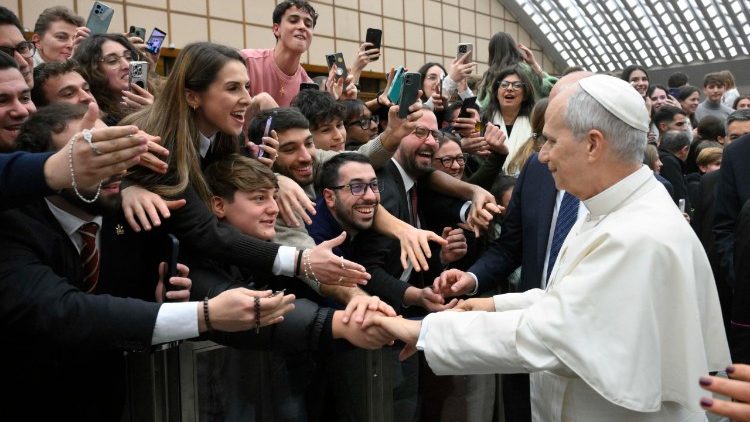
Upon arriving in the Vatican’s Paul VI Hall, Pope Leo XIV was enthusiastically welcomed by the young people of the Diocese of Rome, who greeted him warmly and offered him a moving embrace.
The meeting, held this Saturday, January 10, just days after the conclusion of the Jubilee Year, brought together thousands of young people—accompanied by priests, religious, and educators—both inside and outside the Paul VI Hall.
Pope Leo said that shortly before the meeting he had received a message from his niece, asking how he manages to face so many of the world’s problems and whether he ever feels alone. The answer, the Pope said, was found in the large crowd of young people in front of him.
Pope Leo greets some of the young people in St Paul VI Hall (@VATICAN MEDIA)
Hidden loneliness in the virtual world
Pope Leo did not ignore the unease that many young people suffer: loneliness, disorientation, and boredom, even amid crowds and constant stimulation.
“When this grayness dulls the colors of life, we see that it is possible to be isolated even in the midst of many people,” he said.
According to the Pope, loneliness shows its face when “one is not listened to, because one is immersed in the noise of opinions,” and when “one looks at nothing, because one is dazzled by fragmented images.”
A light that never goes out
Pope Leo also spoke of poetry, evoking verses by Salvatore Quasimodo that speak of human loneliness, but reinterpreted them in the light of faith. The “ray” that pierces the heart, he explained, is not a passing light: “it is not a flickering light that rises only to set again, but the Sun of justice, who is Christ.” And he added: “He warms our hearts and sets them ablaze with his love.”
From this encounter with Jesus, the Pope said, comes the strength to change one’s own life and to transform society. “The light of the Gospel illuminates our relationships,” spreading through everyday words and gestures, until it turns “a gray and anonymous world into a welcoming place, shaped to the human person, precisely because it is inhabited by God.”
Bearing witness without seeking applause
The Holy Father expressed joy at the authentic experiences young people live in parishes, oratories, and charities, but he warned them not to expect easy recognition. “Do not expect the world to welcome you with open arms,” he said, recalling that “advertising, which needs to sell something to be consumed, attracts more attention than witness, which seeks to build sincere friendships.”
Pope Leo therefore urged the young people to “act with joy and perseverance, knowing that to change society we must first change ourselves.”
Prayer breaks the chains
Responding to the young people’s desire to know what they can do concretely to break the “chains” that bind them, Leo XIV was clear: “First of all, pray.” He defined prayer as a deeply real and transformative act: “It is the most concrete act a Christian performs for the good of those around them, for themselves, and for the whole world.”
Prayer, the Pope explained, “is an act of freedom that breaks the chains of boredom, pride, and indifference.”
It is God, Pope Leo said, who kindles the fire of a burning heart, especially when Christians encounter Him in the Eucharist, in the Gospel, and in the Psalms, enabling them to become “the light of the world and the salt of the earth.”
Thank you for reading our article. You can keep up-to-date by subscribing to our daily newsletter. Just click here
Protests have swept Iran, with demonstrators taking to the streets throughout the country
By Nathan Morley
Protests flared again across Iran on Friday night despite a sweeping security crackdown and a nationwide internet blackout.
This is now the 13th night of protests.
Verified videos published by AFP showed large crowds gathering in Tehran, including in the Sadatabad district, where demonstrators banged pots and chanted slogans against Supreme Leader Ayatollah Ali Khamenei.
International responses
In Washington, U.S. President Donald Trump said Iran was in “big trouble,” warning authorities “you better not start shooting because we’ll start shooting too.”
In a letter to the U.N. Security Council, Iran accused the United States of turning the demonstrations into “violent subversive acts and widespread vandalism.”
Early Saturday, U.S. Secretary of State Marco Rubio posted on X that “the United States supports the brave people of Iran.”
The Norway‑based group Iran Human Rights said at least 51 protesters, including nine minors, have been killed in less than two weeks of unrest.
Demonstrations prompted by economic concerns
The demonstrations began December 28, when shopkeepers in Tehran took to the streets after another sharp fall in the value of the rial against the U.S. dollar.
University students soon joined, and protests spread to several other cities.
The full scale of the unrest remains unclear. With internet access severely restricted, only limited footage has emerged and much of it cannot be independently verified.
This week, French President Emmanuel Macron, British Prime Minister Sir Keir Starmer and German Chancellor Friedrich Merz issued a joint statement urging Iran to protect its population and allow freedom of expression and peaceful assembly “without fear of reprisal.”
The current wave of protests is the most widespread since the 2022 uprising sparked by the death of Mahsa Amini, a Kurdish woman who died in custody after being detained by morality police for allegedly violating hijab rules.
More than 550 people were killed and 20,000 arrested during that crackdown, according to human rights groups.
Listen to Nathan Morley's report
Thank you for reading our article. You can keep up-to-date by subscribing to our daily newsletter. Just click here
US, Venezuela explore possibility of restoring relations
A delegation from the Trump administration arrives in Caracas as the United States and Venezuela examine the feasibility of restoring diplomatic relations.
By James Blears
A bi-lateral olive branch, amidst the bramble turmoil of a thorny and momentous week for both nations. The visiting US delegation, follows on the heels of the US intervention, resulting in the capture and detention of President Nicolas Maduro and First Lady Celia Flores.
The US Team is in Venezuela, exploring the possibility of re-opening a US Embassy in Caracas, according to the US State Department. While the Venezuelan Government says it plans to reciprocate, without mentioning exactly when or how they will do the same.
Newly appointed Venezuelan President Delcy Rodriguez says this method and mode of diplomacy is, in her opinion, a way to defend Venezuela, adding that this is the best route to secure the return of Nicolas Maduro and Cilia Flores and to defend independence. Both nations severed diplomatic relations in 2019, during the first administration of President Trump, and this approach towards reproachment, appears to be the first step towards a practical political solution.
In another development President Trump says he’s seeking one hundred billion dollars’ worth of investment for Venezuela`s petroleum industry. But the US oil industry remains wary, guarded, and cautious.
Exxon Chief Executive Darran Woods has reacted by bluntly stating: “We have had our assets seized twice. To re-enter a third time, we would require some pretty significant changes. Today, it’s uninvestable.”
Listen to James Blears' report
Thank you for reading our article. You can keep up-to-date by subscribing to our daily newsletter. Just click here
Pope Leo: Failure to welcome abuse victims is a scandal
The full text of Pope Leo XIV’s speech at the conclusion of the January 7–8 consistory, published today, announces a new meeting of the cardinals in June and insists that victims and survivors of abuse “need to be accompanied with the closeness of authentic pastors.”
By Salvatore Cernuzio
Although it was not a specific topic of the Extraordinary Consistory held on January 7–8, Pope Leo XIV took the opportunity to speak to the roughly 170 cardinals—both electors and non-electors—about a problem that “remains a real wound in the life of the Church in many places”: the sexual abuse crisis.
This is a topic Pope Leo, like his predecessors, has repeatedly highlighted in recent months. Even in the Consistory—focused on the themes of synodality and mission, chosen by majority vote of the cardinals—he did not fail to mention this issue.
He addressed it in his concluding speech after the two day meeting, the full text of which was published on January 10.
The scandal of closed doors
In his address, the Pope stressed that “abuse itself causes a deep wound, which may last a lifetime; but often the scandal in the Church is that the door was closed and victims were not welcomed or accompanied with the closeness of authentic pastors.”
The Holy Father shared the testimony of a victim he had spoken with recently: “She told me that the most painful part for her was that no bishop wanted to listen”. There, Pope Leo said, “listening is profoundly important.”
Next steps
Listening is also a necessary practice between the Pope and the College of Cardinals. For this reason, the Holy Father asked the cardinals to continue the work begun at the Consistory, to deepen mutual understanding, strengthen dialogue, and implement synodality.
Pope Leo announced plans to “continue the meetings” in the future, possibly extending them to three or four days once a year. As some groups suggested, the meetings could consist of a day of reflection, prayer, and encounter, followed by two or three days of work.
For this year, he scheduled a second Consistory at the end of June, near the Solemnity of Saints Peter and Paul.
“I would suggest that, for this year, we meet a second time for two days,” the Pope said, also encouraging cardinals who “face financial difficulties” to seek assistance. “Speak up. I think we, too, can show solidarity with one another, and there will be ways, with generous people who will help.”
Submitting proposals and feedback in writing
The work is not over, the Pope highlighted, as “the dialogue is meant to continue.” He asked the cardinals to “submit in writing” their reflections on the four proposed themes—synodality, mission, liturgy, and the constitution Praedicate Evangelium.
Pope Leo during the Extraordinary Consistory (@Vatican Media)
They were also meant to share their overall assessment of the Consistory and the “relationship of the cardinals with the Holy Father and the Roman Curia.”
He promised to “take time to read reports and personal messages carefully, and later give you feedback, a response, and continue the dialogue.”
Gratitude for participants and solidarity with absentees
In his final address, the Pope reflected positively on this initial experience of collegiality, which he said “is intimately connected to what we experienced at the Conclave,” during which many cardinals had expressed “the desire to get to know each other and to contribute and support.”
The Consistory was thus “a privileged moment to express the mission of the Church together, in communion.” Pope Leo expressed his “deep gratitude” for the presence and participation of the cardinals, all directed toward supporting him in his service as Successor of Peter. He especially thanked the senior cardinals who made the effort to attend as “their testimony is truly precious.”
At the same time, he expressed solidarity with those unable to attend for various reasons: “We are with you and feel you close!” He added, “Personally, I felt profound communion and harmony with all of you and among the many interventions.”
The importance of formation
Reflecting on points raised during the work, particularly by the 20 language-based groups, the Pope highlighted the importance of formation. “Formation for everyone”—in seminaries, for priests, bishops, and lay collaborators—“must be rooted in the ordinary, concrete life of the local Church, the parishes, and other significant places where people meet, especially those who suffer.”
The language groups during the Consistory (@VATICAN MEDIA)
Because such topics cannot be fully addressed in a short time, this ordinary work must become “an opportunity for formation and growth for those with whom we work, at all levels, from the parish to the Roman Curia.” Examples include pastoral visits and the revitalization of participatory bodies.
Synodality and mission, rooted in the Council
Regarding the two themes chosen by the cardinals—synodality and mission—the Pope reiterated that they “are deeply rooted in Vatican II and the entire path that has flowed from the Council.”
He emphasized that “this path is a process of life, conversion, and renewal for the entire Church.” The other two themes were not “necessarily central” during the two days but “are closely connected to the other themes and to the Council,” he said, “so they have not been nor will be forgotten.”
The service of the Curia
Pope Leo also mentioned the work of the Dicasteries in the spirit of Praedicate Evangelium, serving the Pope and the particular Churches. The Apostolic Constitution, published in October 2022, highlights the need to “better harmonize” the service of the Curia with the path of evangelization.
The Holy Father reiterated his commitment to providing the cardinals and the whole Church “a structure of relationships and service, capable of supporting you and local Churches to address the current challenges of the mission more effectively.”
“This,” he continued, “is connected to the ongoing implementation of the Synod, which will have a key milestone in the 2028 Ecclesial Assembly.” He encouraged the cardinals to be “ferment for this path” in service of the Church’s mission and the proclamation of the Gospel.
Support for those suffering from war and violence
Concluding his speech, the Pope stressed the importance of sending hope to today’s world: “We are not gathered here deaf to the reality of poverty, suffering, war, and violence that afflict so many local Churches. And here, with them in our hearts, we also want to say that we are close to them. Many of you come from countries experiencing this suffering from violence and war.”
Pope speaking to the Cardinals during the Consistory (@Vatican Media)
This path of hope must also engage the young, he said. The hope experienced in the recently concluded Jubilee reminds us: “We have closed the Holy Door, but let us remember: the door of Christ and His love is always open!”
The full text of the Pope's concluding speech can be found here in Italian
Thank you for reading our article. You can keep up-to-date by subscribing to our daily newsletter. Just click here
Pope to Jubilee partners: Thanks to you, Rome had a welcoming face
Meeting with the representatives of the institutions that collaborated in the Jubilee, Pope Leo expresses his gratitude for their “multifaceted contribution, often hidden” throughout the year and encourages them continue to carry hope in their hearts.
By Kielce Gussie
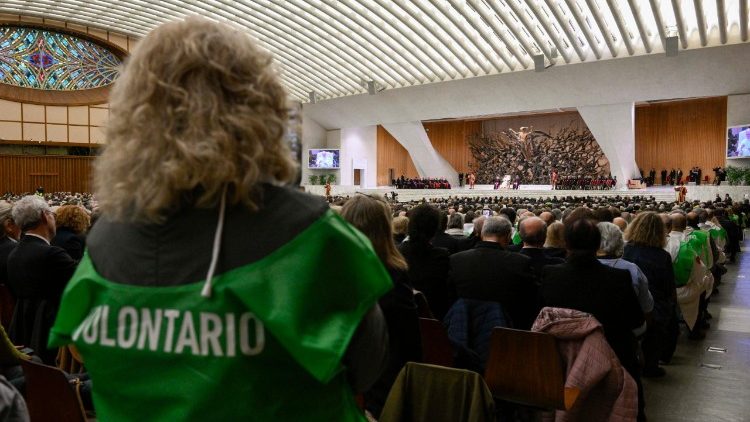
In the Paul VI Audience Hall, Pope Leo XIV started his Saturday morning by greeting all the authorities, as well as members of civil and ecclesial institutions who contributed to the celebration of the Jubilee Year of Hope. Specifically, the Pope expressed his gratitude to the Italian government, security forces, and all the Dicasteries involved, along with many others.
These organizations and institutions, he explained, “offered a multifaceted contribution, often hidden, always demanding and full of responsibility, thanks to which more than thirty million pilgrims were able to undertake the Jubilee journey”.
Hope is a part of being a pilgrim
These visits to the Holy Doors and tombs of the Apostles were tangible experiences of a hope that does not disappoint. Pope Leo highlighted how St. Augustine wrote that “hope is necessary in the condition of pilgrims”, and these volunteers made it possible for visitors to rediscover hope.
In particular, the Holy Father emphasized the large number of young people who travelled to the Eternal City from all corners of the world. He described their witness as beautiful because they were “so different from one another, yet united and orderly (also thanks to your precious service!)”
Pope Leo greets some of the Jubilee volunteers and collaborators (@Vatican Media)
Everyone, he argued, has a responsibility to these young people and their future. So, he encouraged the volunteers to ask themselves in the light of the Jubilee experience: What do these young people truly need? Where can they discover true answers to the deepest questions they have in their hearts?
It is important for them to have good role models to whom they can look for guidance on the path to holiness. For instance, they can look to the examples of St. Pier Giorgio Frassati and St. Carlo Acutis.
May the seeds of hope grow
In the Bull of Indiction at the opening of the Holy Door in 2024, Pope Francis made an appeal to hope in these words: “Let us allow ourselves to be drawn even now by hope, and let us allow it to become contagious through us for all who long for it.”
Over a year later, his successor Pope Leo, reiterated that call—let it be the “mandate we carry with us, as a fruitful continuation of the work accomplished”, so that the good seeds that have been placed on our hearts can continue to grow.
Archbishop Rino Fisichella also expressed his appreciation to the various groups that helped realize the Holy Year (@Vatican Media)
Concluding, the Holy Father presented the volunteers with “a small sign of gratitude, the Jubilee Crucifix: a miniature of the cross with the glorious Christ that accompanied the pilgrims.” He offered it as a reminder of the unique experience they have just completed.
“I bless you and wish you every good for this new year. Thank you!”
Thank you for reading our article. You can keep up-to-date by subscribing to our daily newsletter. Just click here
Latin Patriarchal Vicar of Jordan: Focusing on differences won’t bring peace
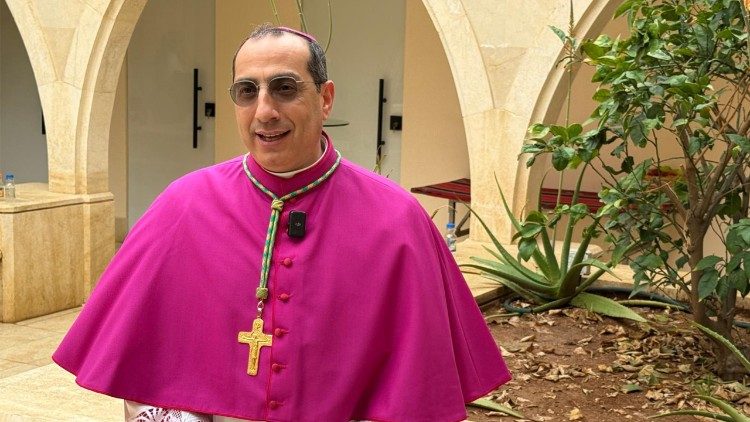
The Latin Patriarchal Vicar of Jordan speaks to Vatican News at the “Baptism of the Lord” Church in Bethany Beyond the Jordan on the occasion of the pilgrimage and Mass for the Feast of the Baptism of the Lord, on Friday, 9 January. The Bishop stresses the need to respect religious and cultural differences in order to foster peace and justice in the Middle East.
By Claudia Torres – Jordan
The Latin Patriarchal Vicar of Jordan, Bishop Iyad Twal, spoke to Vatican News at the “Baptism of the Lord” Church in Bethany Beyond the Jordan, on the occasion of the pilgrimage and Mass for the Feast of the Baptism of the Lord, on Friday, 9 January.
The Bishop stressed the need to respect religious and cultural differences in order to foster peace and justice in the Middle East
The Bishop stressed the need to respect religious and cultural differences in order to foster peace and justice in the Middle East, and he offered the Hashemite Kingdom of Jordan, a Muslim-majority country with a small but active Christian presence, as an example of coexistence.
The following is a transcript of the interview, which has been lightly edited for clarity.
Can you tell us the significance of the celebration today at the place of Jesus’ Baptism in Jordan?
We are very happy and proud of being Jordanians, Christians, Catholics, and today, the Feast of the Baptism, means a lot for us on a national level and the local level, and also for our Churches. We were here from all the parishes - from the north and the south - to come to pray together. Praying together, it’s a sign that we belong to this land, to the Holy Land, and we are also part of our community, our people, and our nation here in Jordan. The Baptism of our Lord is a sign of the opening of the heavens, of the sky, of God’s blessing upon us all. So we hope that we, being Christians, Catholics, Jordanians, we can participate in building peace and justice through the witness that we do in Jordan and in the whole Middle East.
Where do you see this path to peace in the Holy Land, given the situation in the region?
I think the path is very difficult, but it’s very clear. I think the problem is that we know that we want peace, we need peace. But to reach it, it’s not easy. But we can do it, if there is the will to do that, if we exclude religious identities, if we exclude all the differences. What I mean is that there are always differences everywhere we go, in every nation. But if we think and we focus only on what’s different, or what makes the other different than me, I think we will never reach the peace that we want. We need to come to an idea, an attitude, or a position that we are different maybe in religions, we are different in culture, we are different in heritage, but we have to respect each other. We respect the human being and his dignity, believing that God is love for everyone and we can live together.
“Baptism of the Lord” Church in Bethany Beyond the Jordan
In Jordan too, I’ve noticed that there is this attitude of openness…
Yes, in Jordan we do have this culture, a culture of hospitality, of accepting each other, of belonging to the nation, to the country, and the Hashemite family, and thanks to the King and his family – they are really a sign of unity. We are trying with our young people, through education – for example, schools, parishes – to keep this path, this example of coexistence and witness alive for us and for everyone around us.
What would you say the Catholic Church in Jordan can contribute to the greater Church around the world?
The Catholic Church in Jordan is very rich, because we have the Latins here but also the Maronites with us. We have the Melkites; we have the Syrian Catholics; we have the Armenian Catholics. So it’s a sign of the universality of the Church in Jordan and we are also living together. We have the biggest chain of schools in the Kingdom serving our people: rich and poor. We have the university too. So we have a role. Once, I was talking with Pope Leo about how we are trying to build bridges with everyone. This is our mission as a Catholic Church. The idea that in number we are small in Jordan, but we are so big in terms of the Catholic Church all over the world. So we are inviting our brothers and sisters to join us, to come to Jordan, to visit Jordan, that we, with you, can be the example of what it means – a Catholic Church – in Jordan and everywhere.
Thank you for reading our article. You can keep up-to-date by subscribing to our daily newsletter. Just click here