Jesus deliberately chose only men as Apostles. His female disciples were given a different, though no less important, role. Like his predecessors, Pope Francis is committed to involving both women and men in the governance of the Church, within the situation defined by Jesus.
The Apostles passed their ministry on to their successors (the bishops) and their helpers (priests and deacons). In the Western Catholic Church, priests and bishops in principle remain unmarried. They have freely chosen to totally dedicate themselves to Jesus in a celibate state of life, and to follow Jesus’ example in everything. This allows them to be completely free to go where Jesus and the Church send them.
Consistory: Fourth session focuses on the Synod and priesthood
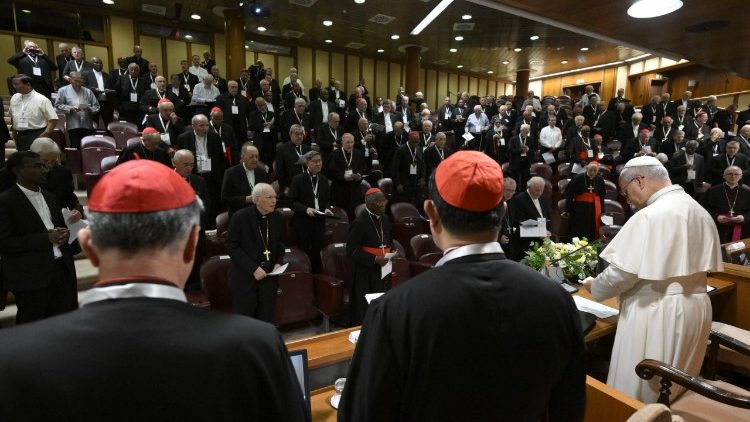
During the fourth session, the cardinals reflect on the need to offer the clergy an image of the priesthood that is “beautiful, creative, evangelical, and at the same time not clerical.” They also discuss the risk that the complexity of consultation processes could weigh down the Church precisely at a time when it is called to bear witness to the world.
Vatican News
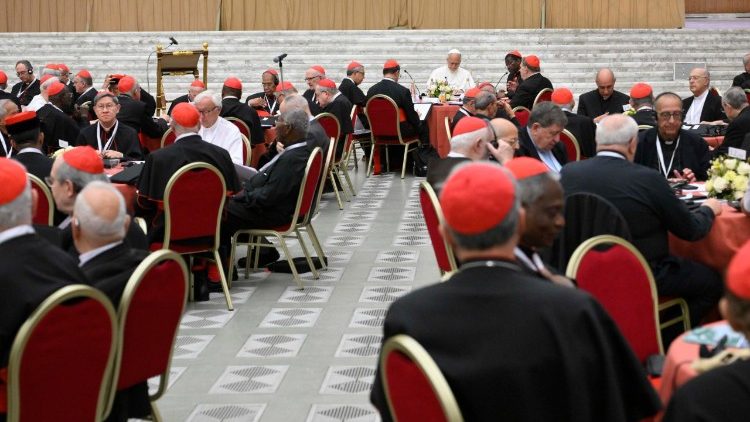
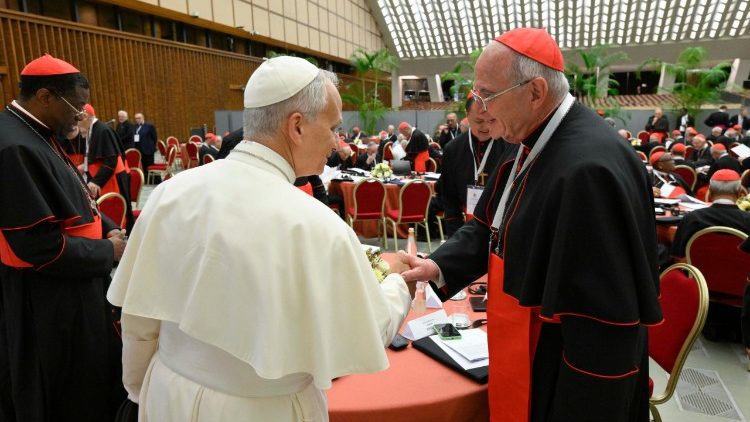
The first part of the fourth session of the Extraordinary Consistory began on Saturday afternoon at 4 p.m. Some of the themes that emerged included deepening the ascetical and historical dimensions of synodality, while offering the faithful an image of the priesthood that is both evangelical and non-clerical. A press release from the Holy See Press Office reported that the work took place in the Aula del Sinodo (New Synod Hall), and was moderated by Cardinal Joseph William Tobin.
Not “weighing down” the Church
After the introductory report by Cardinal Mario Grech, several cardinals took the floor.
According to the Press Office, the cardinals addressed the risk that “the complexity of consultation could weigh down the Church at a time when it is called to give its witness.” At the same time, it was reaffirmed that both the hierarchical Church and the People of God participate, though in different ways, in “the discernment of what the Spirit is saying to the Church.”
The cardinals also highlighted the contribution of Eastern Catholic communities, whose synodal experience represents a significant contribution to the journey involving the entire Church.
The first part of the session ended at 5 p.m. After a break, the program foresees a dialogue with Pope Leo XIV, with participants free to speak for up to three minutes each.
Thank you for reading our article. You can keep up-to-date by subscribing to our daily newsletter. Just click here.
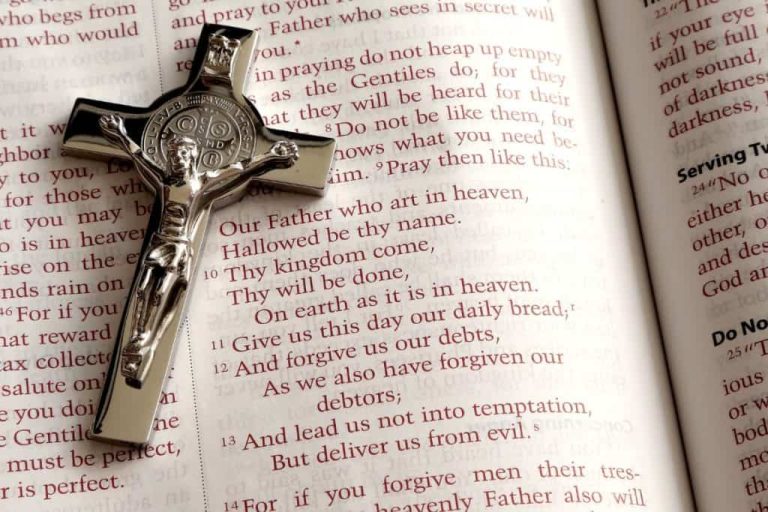
Our Father, who art in heaven,
hallowed be thy name;
thy kingdom come,
thy will be done
on earth as it is in heaven.
Give us this day our daily bread,
and forgive us our trespasses,
as we forgive those who trespass against us;
and lead us not into temptation,
but deliver us from evil.
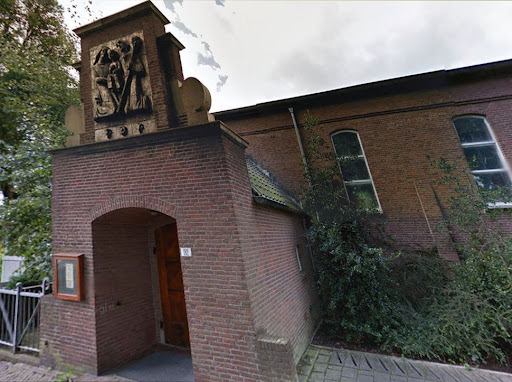
The Parish of the Blessed Trinity is an International English-speaking Roman Catholic Community and is under the pastoral care of Father Peter Klos. The church has members consist of about 48 nationalities. Masses are held in the Holy Family Church. The church is located in a charming "village" in the Betondorp district of Amsterdam East. There are two aisles in the church with beautiful stained glass windows. There is a bell tower built in traditionalist forms under the influence of the Delft School.
DeoQuest | Artificial insemination, embryos, and cloning
What about artificial insemination and surrogate mothers?
Children are the fruit of an intimate experience of love between a man and a woman. The Church can only accept medical procedures that retain the connection between this union and procreation. Therefore, the Church rejects almost all methods of artificial insemination, even though she understands very well the grief of couples who cannot conceive children.
Surrogate motherhood leads to all sorts of unnatural and inhuman situations, and should always be rejected.
Consistory: Third session upholds Gospel hope as antidote to individualism
During the third session of the Extraordinary Consistory, the Cardinals reflected on the Church’s mission to foster goodness and build up society.
Vatican News
The Holy See Press Office released details of the third session of the Extraordinary Consistory, held on Saturday morning in the Paul VI Hall.
The day began with Mass celebrated by Cardinal Giovanni Battista Re, Dean of the College of Cardinals, in St. Peter’s Basilica.
Meeting in the Paul VI Hall, Pope Leo XIV led the Cardinals in praying the Adsumus prayer.
Cardinal Protase Rugambwa, Archbishop of Tabora, Tanzania, moderated the morning session.
He thanked the College in the Pope’s name for its words of support for his appeals for peace, and urged them to make those appeals even more effective by taking responsibility for them in their dioceses and regions of origin, so that a choral appeal may rise up and give still greater strength to this common commitment.
Cardinal Stephen Brislin, Archbishop of Johannesburg, Soth Africa, then took the floor for his introductory report on the theme “Building in the good: the worksites of our time.”
After a time of prayer and silence, Cardinal Rugambwa opened the group work, setting the return to plenary session, after the break, for 11:30 a.m.
The Pope, who was present for the beginning of the session, returned before the group reports.
Eleven groups reported in the Hall: the eight from the first set and three from the second.
A large number of the groups focused their reflection on a reading of the deep fractures of our time: among peoples and nations, within societies, and within families themselves; and on how these generate wounds, especially among the poorest, the weakest, young people who lack a sense of newness, and adults lacking the wisdom of years.
Many of the reports highlighted the danger posed by a lack of meaning, meaningful relationships, and identity, which pushes people toward a tribal attitude. All emphasized the role of an exaggerated individualism that leads to the illusion that others exist for our own success.
In this context, the challenge of artificial intelligence emerges as an anthropological dimension that must be examined by identifying shared human values.
These begin with the call to give names to living beings, and not to reduce them to numbers and statistics; to experience and accept the human sense of limits, which AI tends to deny; and to defend the dignity of work.
Within this framework, many groups spoke of the value of the common good as something difficult to embrace and understand, and which politics often does not seek. They noted how it requires a language of the heart in order to overcome conformism, corruption, and the sense of impossibility generated by the awareness that the property and resources needed to achieve it are in the hands of a few.
The sense of the common good, numerous groups affirmed, has its origin in faith: faith in God and in the transcendent dimension present in every person, which leads human beings to go beyond every frontier, beginning with the one that takes them beyond themselves; to live solidarity with the poor as a response to individualism; to live catholicity fully; to build gratuitous relationships, not institutions, at every level; and to seek a language capable of engaging with settings distant from the Christian faith.
In this regard, the role of politics is essential, as is the commitment of ecclesial institutions to the formation of future public servants, so that the Church’s social doctrine may be known and studied as a medicine for divisions.
The antidote to individualism and to fractures, many groups agreed, is the Gospel: a Church that offers a sense of belonging, that is able to soothe the wounds of our time, and that is renewed while avoiding forms of integralism and polarization; a Church that makes visible its Samaritan face, with Christians who are not spectators of social ruin, but wise architects who rebuild the city of all.
In this framework, one sign of hope is the recognition that the same challenges are being faced in many areas and in many parts of the world, and that communion with Christ makes one less concerned about what others think.
In this sense, various groups emphasized the value of synodality as a path of listening and dialogue, and also of ecclesial responsibility.
At the end of the reports, time was given for interventions by several Cardinals, who took up the themes of the session in more personal terms. Others expressed gratitude to the Pope for his recent apostolic journeys and his commitment to peace.
The session ended at 12:45 p.m. with the Angelus prayer, led by the Holy Father.
Thank you for reading our article. You can keep up-to-date by subscribing to our daily newsletter. Just click here.
To conclude the month of the Sacred Heart, we wish to pray for His Eminence Cardinal Eijk, who occasionally struggles with health issues, including recently, for: strength, fortitude, and good health.
It will be the novena of Divine Mercy. The Lord recommends praying this novena more often throughout the year. This time, we wish to implore GOD’s mercy for our Archbishop.
Cardinal Brislin: Human progress must serve dignity and common good
Opening the third session of the Extraordinary Consistory, Cardinal Stephen Brislin reflects on Pope Leo XIV’s encyclical Magnifica humanitas, saying the Church is called to engage the struggles of history with a synodal approach rooted in faith, charity, and hope.
Vatican News
Cardinal Stephen Brislin, Archbishop of Johannesburg, in South Africa, opened the third session of the Extraordinary Consistory by inviting the Cardinals to reflect on how humanity is “building” its future in an age marked by technological power.
Speaking on the theme “Building for the common good: the building sites of our time,” Cardinal Brislin focused on the relationship between the introduction and conclusion of Pope Leo XIV’s encyclical Magnifica humanitas.
He said the two sections reveal the theological framework of the entire document: the opening pages raise “crucial questions” about the way humanity shapes its future, while the conclusion shows how those questions find a Christian answer in the theological virtues lived in history and sustained by prayer.
The Cardinal noted that the encyclical begins with a comparison between Babel and Jerusalem. Both cities, he said, evoke a shared human endeavour, since in both people build together. The decisive question, however, is the direction of that building.
Babel, he explained, turns in on itself and transforms human intelligence into a project of self-sufficiency, showing that unity sought without God leads to fragmentation and disintegration.
Jerusalem, by contrast, points to an effort in which human intelligence, placed at the service of God, becomes capable of promoting the dignity of every person.
Cardinal Brislin said this comparison raises a central question for the present age: what form does human endeavour take when it has access to ever more powerful tools?
The question concerns artificial intelligence and new technologies, but also the broader issue of whether technical progress is accompanied by responsibility or whether it exposes people to new forms of exclusion.
For this reason, he said, Magnifica humanitas invites everyone to pay attention to how we are building together.
Technical tools are never neutral, but are embedded in political, economic, social, and educational processes that shape the quality of shared life.
For believers, this call takes on the form of synodality. Cardinal Brislin described synodality as the concrete trace of the communion from which the Church is born and grows, enabling Christians to enter the building site of history without fear.
He said the encyclical offers a “grammar of building” centred on four elements: desire, limitation, shared responsibility, and discernment.
Human desire for happiness must be safeguarded in truth, while the recognition of limits reminds us that life is a gift to be received and protected.
Shared responsibility, he continued, reflects the principle of subsidiarity: no one possesses the entire project, and no one builds alone.
Discernment, guided by the Church’s social doctrine, helps distinguish what serves the person from what creates dependence or exclusion.
In the conclusion of the encyclical, Cardinal Brislin said, this grammar is fulfilled through faith, charity, hope, and prayer.
Faith recognizes God’s mercy in history; charity finds its source in the Eucharist; hope sustains the building of the civilization of love; and prayer opens the Church to the action of the Holy Spirit.
In this way, he concluded, Magnifica humanitas entrusts the Church with a specific responsibility: to face the struggles of history in its own distinctive way, through a synodal approach rooted in the theological virtues and focused on serving the human person.
Thank you for reading our article. You can keep up-to-date by subscribing to our daily newsletter. Just click here.
The Saint John’s Cathedral International Community is a community that is willing to welcome and accompany our foreigner brothers and sisters in their effort of integration into our Dutch society and local church. This is about a commitment with all together to build up a community that allows us to strengthen, deepen and promote the catholicity of our Catholic Church, which is house for everyone. The setting of
Saint John’s Cathedral International Community also follows on the exhortation of our new Pope Leo XIV who, in his Homily of inauguration has invited us, “under the guidance of the Holy Spirit, to build a Church based on the love of God and sign of unity, a missionary church that open her hands to the world and announce the Gospel to everyone” (Pope Leo XIV). It is a special opportunity for our foreigner brothers and sisters to integrate new community and to meet new friends. We want to form a church-family that gives to our brothers and sisters the opportunity to live deeply their faith despite the non-stop growing secularization as it is experienced in our land, the Netherlands. And celebrating the Liturgy together, has the power to achieve all the hereabove mentioned objectives, since Liturgy is an act of worship that is not a mere combination of rituals and symbols, but a practice that helps us as believers to enter into a deep relation with God and with one another.
Please, feel free to join us on every First Sunday at 3 pm of every month.
Contact
Torenstraat 16, 5211 KK 's-Hertogenbosch, Nederland
What are the origins of the Church? How did it all start?
Jesus assembled the first Apostles and so established the Church. Our current bishops and the pope are the successors of the Apostles. From the very beginning, the Apostles delegated tasks to bishops. The Church is made up of the bishops together with all the other faithful.
In the community of the Church we learn to live together and to pray properly. In this way we are being prepared to live together with God in heaven. By speaking about the Gospel, other people are given an opportunity to join this community as well, and thus come closer to God.
Caritas Venezuela president says priority is the injured and search for survivors
Faced with the devastation caused by two earthquakes, Archbishop José Luis Azuaje Ayala is calling for an unrelenting search for the thousands of people still missing, urging civil society, private companies, and government agencies to "work together so that everyone can help address this difficult situation."
By Alina Tufani Díaz
“We ask everyone to pray for this country, for all those who are suffering, and also for those engaged in the rescue efforts.”
Speaking to Vatican News, Archbishop José Luis Azuaje Ayala, President of Caritas Venezuela, urged the international community not to lose sight of the consequences of last Wednesday's devastating earthquakes. He stressed above all the need to intensify the search for those who may still be trapped beneath the rubble.
The Archbishop also called for an immediate assessment of buildings and infrastructure that remain at risk of collapse due to the numerous and powerful aftershocks. He appealed for “a coordinated effort between government agencies and civil society to help minimize the consequences of this tragedy.
Nearly three days after the twin earthquakes, measuring 7.2 and 7.5 on the Richter scale, struck central and northeastern Venezuela, official figures report at least 920 deaths, more than 3,000 people injured, and over 50,000 still missing. According to several non-governmental organizations specializing in emergency response, those numbers could rise significantly.
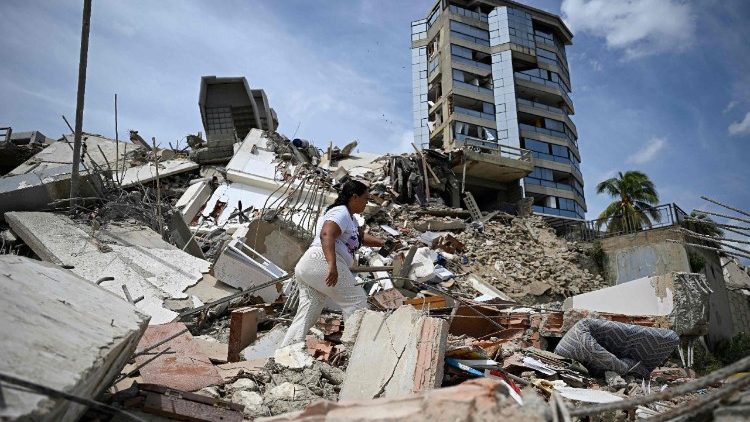
Rescue teams and volunteers search through the rubble of a building in Caracas. (AFP or licensors) (AFP or licensors)
The Venezuelan government has declared a national state of emergency in the Capital District and the states of La Guaira, Falcón, Carabobo, Yaracuy, Aragua, Miranda, Trujillo, and Lara. The most severe devastation, however, has been reported in La Guaira, just a few kilometers from the capital and home to the country's main port and international airport.
Fears for the missing
Archbishop Azuaje, Metropolitan Archbishop of Maracaibo—a region not directly affected by the earthquakes—said authorities are still assessing the full extent of the human and material damage, particularly to homes in the hardest-hit areas, parts of Caracas, and especially along Venezuela's central coast, where both the destruction and seismic activity have been most severe.
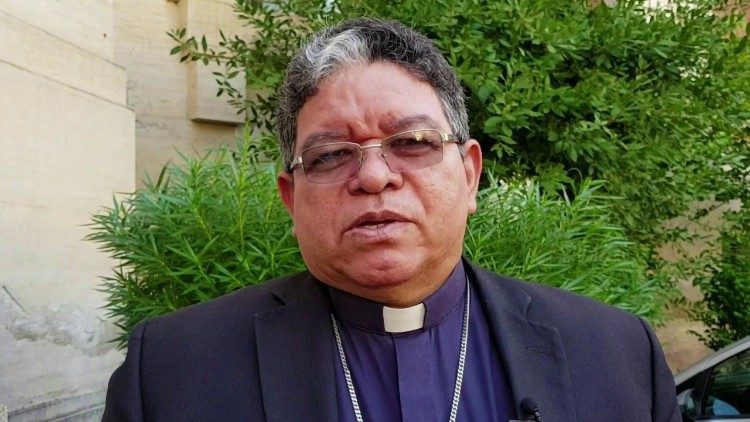
Archbishop José Luis Azuaje Ayala, President of Caritas Venezuela, is also the Metropolitan Archbishop of Maracaibo
“Many people remain missing, and it is believed they are still buried beneath the rubble of several buildings,” the Archbishop said. He noted that not only residential buildings collapsed, but also hotels, recreational facilities, and commercial premises.
“The authorities continue to assess the situation, particularly the search for people who remain buried and trapped,” he added.
Thousands displaced
Archbishop Azuaje confirmed that “thousands of people are sheltering in public squares and open spaces, fearing aftershocks that could bring down additional buildings and infrastructure already severely damaged.”
He also expressed concern over the critical condition of the electricity grid and drinking water distribution systems, which were already under strain and have now completely collapsed in some areas.
Meanwhile, dioceses across the country are organizing collection centers through the Caritas network and other organizations. Efforts are also underway to identify shelters for those who have lost their homes because, the President of Caritas Venezuela noted, “this situation will continue for a long time.”
Aftermath of earthquakes in La Guaira (MAXWELL BRICENO)
It is estimated that more than 70,000 families have been left homeless in La Guaira state alone.
Hospitals under severe strain
The Archbishop also highlighted the serious condition of several damaged hospitals. “Doctors and healthcare workers are doing everything they can, especially to care for the injured and the many people arriving in a state of emotional collapse and suffering from the many consequences of these two simultaneous earthquakes.”
He outlined the immediate priorities: caring for the injured, continuing the search for possible survivors, assessing infrastructure vulnerable to aftershocks, and coordinating efforts between government agencies and civil society “to work together to minimize the consequences of this tragedy.”
Caritas Venezuela, he added, “has been on the ground since the early hours of the morning, especially in the hardest-hit areas, with the primary goal of assisting in the rescue of victims trapped beneath the rubble, while also searching for missing persons at locations identified by relatives and friends.”
The psychological toll of the disaster
The psychological impact of the disaster—including widespread anxiety and uncertainty caused by the continuing aftershocks of varying intensity expected over the coming days—has become another major priority for Caritas Venezuela.
Emergency treatment centers are caring for the injured as hospitals become overwhelmed. (AFP or licensors) (AFP or licensors)
“As Caritas and as the Catholic Church,” Archbishop Azuaje said, “we are trying to help everyone as much as possible so that they can find hope and, above all, overcome the psychological and emotional crisis that unfortunately brings uncertainty and many other negative consequences into people's lives.”
A call for help
The President of Caritas Venezuela appealed to the entire national and international community to contribute through financial donations as well as non-perishable food, medical supplies, first-aid equipment, and any other resources that can help respond to the disaster.
Many families who have been unable to secure emergency shelter are living outdoors. (MAXWELL BRICEÑO) (MAXWELL BRICENO)
“This is what we are working on,” he said, “and above all we are encouraging civil society, private companies, and government agencies to join forces so that everyone can contribute to addressing the difficult situation our country is facing.”
A prayer for Venezuela
Archbishop Azuaje concluded by expressing gratitude for the Christian compassion and charity shown by the many institutions and countries that have stood in solidarity with the Venezuelan people during this difficult time.
“We ask everyone,” he said, “to pray for this country, for all those who are suffering, and also for those who are helping, so that the Lord may grant strength and encouragement—especially to those digging through the rubble—to continue working for the good of so many people.”
Thank you for reading our article. You can keep up-to-date by subscribing to our daily newsletter. Just click here.