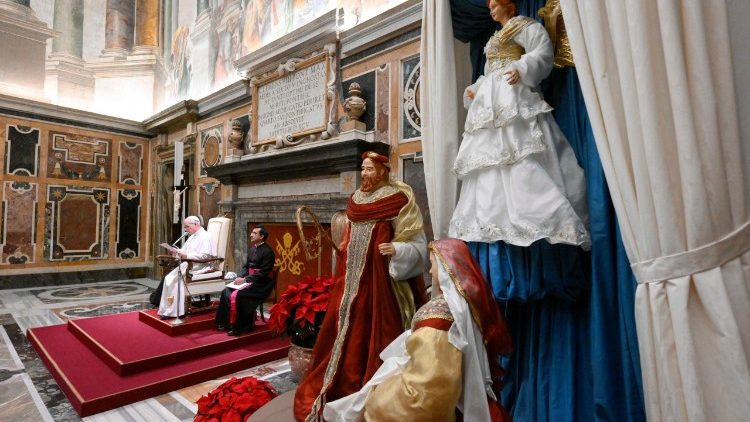












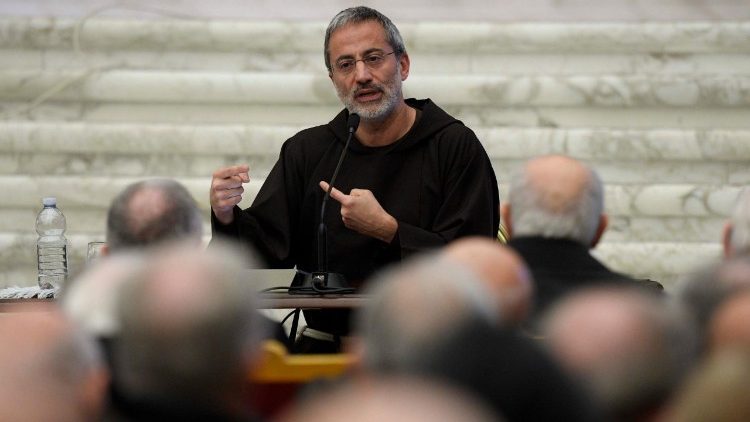
Fr. Roberto Pasolini, the Preacher of the Papal Household, delivers his second Advent meditation to Pope Leo XIV and members of the Roman Curia.
By Isabella Piro
What kind of unity must we bear witness to? And how can we offer the world a credible form of communion that is not simply generic fraternity?
These were the questions at the heart of the second of three Advent sermons delivered by Father Roberto Pasolini, preacher of the Papal Household, on Friday morning to Pope Leo XIV and the Roman Curia.
The chosen theme for the three reflections was: “Awaiting and hastening the coming of the day of God.”
The Tower of Babel
Fr. Pasolini structured his reflection around three images: the Tower of Babel, Pentecost, and the reconstruction of the Temple of Jerusalem.
The first image, the Tower of Babel, embodies a humanity which, after the flood, tries to exorcize “the fear of being scattered.” But that project hides “a deadly logic,” because it pursues unity “not through the reconciliation of differences, but by means of uniformity.”
20th-century totalitarianism
This is the “dream of a world where no one is different, no one takes risks, everything is predictable,” Fr. Pasolini observed, noting that the builders of the tower used not irregular stones but uniform bricks, all identical.
The result is unanimity, he said, but one that is only apparent and illusory, because it is “achieved at the price of eliminating individual voices.”
The preacher then turned to consider contemporary times, pointing to the totalitarian regimes of the 20th century, which imposed “a single-minded ideology,” silencing and persecuting dissent.
Yet, “whenever unity is built by suppressing differences,” he warned, “the result is not communion but death.”
Social media and AI
Even today, Fr. Pasolini said, “in the age of social media and artificial intelligence,” the risks of homogenization have not disappeared—indeed, they appear in new forms: algorithms that create “single-track information bubbles,” predictable patterns reducing human complexity to standards, and platforms that chase instant consensus while penalizing “reflective dissent.”
The Church, the Capuchin friar added, is not immune to this temptation, since often in history the unity of faith has been mistaken for uniformity, to the detriment of “the slow rhythm of communion, which does not fear dialogue and does not erase nuances.”

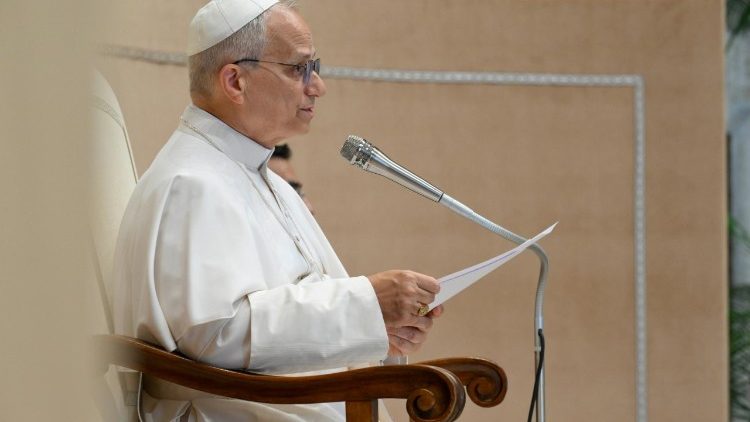
Pope Leo listens to the Advent reflection (@VATICAN MEDIA)
Difference: the grammar of existence
A world built on the utopia of identical copies, Fr. Pasolini continued, “is the antithesis of creation,” because “God creates by separating, distinguishing, differentiating”: light from darkness, the waters from the dry land, and day from night.
In this sense, “difference is the very grammar of existence,” and rejecting it means reversing “the creative impulse” in search of a false security that is in fact “a refusal of freedom.”
The confusion of languages with which God responds to Babel, therefore, is not a punishment but “a cure,” the preacher emphasized. God “restores dignity to particularity,” giving humanity once more its “most precious gift”: “the possibility of not all being the same.”
After all, “there is no communion without difference.”
Pentecost
Fr. Pasolini’s second image, Pentecost, thus becomes an emblem of communion without uniformity. The apostles speak in their own languages, and the listeners understand in theirs, because “diversity remains, but it does not divide.”
Differences are not eliminated to create unity; they are transformed “into the fabric of a broader communion.”
Renewal of the Church
Fr. Pasolini then turned to discuss his third image: the Temple of Jerusalem, destroyed and rebuilt multiple times.
Every reconstruction, he said, “can never be a linear process,” for it is shaped by “enthusiasm and tears, new momentum and deep regrets.”
All this serves as “a precious compendium” for understanding “the perennial necessity of the Church’s renewal,” so well embodied by St. Francis of Assisi.
The Church is called to allow herself to be rebuilt again and again, so that “the beauty of the Gospel” may shine through, remaining faithful to itself while continuing “to place herself at the service of the world.”
Thank you for reading our article. You can keep up-to-date by subscribing to our daily newsletter. Just click here
© Dicastery for Communication – Vatican News