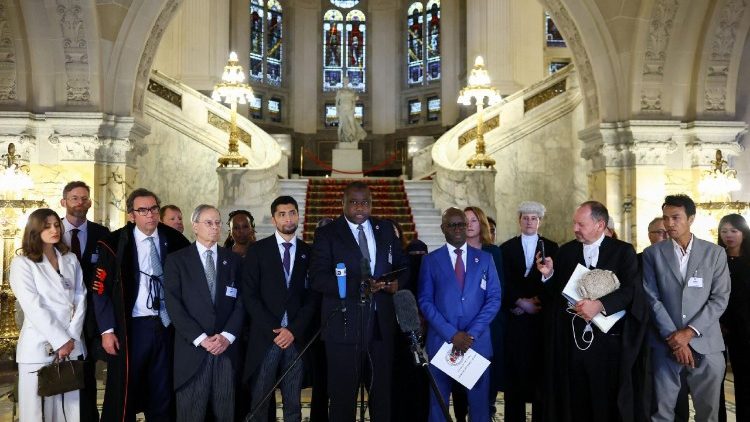
Myanmar has been held responsible for the atrocities committed by the military against the Muslim Rohingya minority in 2017.
By Lorenzo Freggiaro
In 2019, The Gambia, backed by the 57-member Organisation of Islamic Cooperation, brought a case against Myanmar before the International Court of Justice (ICJ).
It asked the judges to rule that Myanmar breached the 1948 Genocide Convention, to end any unlawful acts against the Rohingya population and to ensure those responsible are punished.

Members of the International Court of Justice (ICJ) ahead of a public session for the reading of the court’s judgment in the genocide case brought by The Gambia against Myanmar at the Peace Palace in The Hague, Netherlands (ANSA)
The Gambia also sought reparations, full citizenship for Rohingya, and their right to return home.
Myanmar rejects the accusation. It calls its campaign a legitimate counterterrorism operation.
Why the Rohingya fled
In August 2017, Myanmar’s army launched a “clearance campaign” in northern Rakhine State, after insurgents attacked police posts and an army base.
More than 730,000 Rohingya fled to Bangladesh. Survivors speak of mass killings, rape, and burned villages. A UN fact-finding mission found “genocidal acts.”
Today, about 1.2 million refugees live in the crowded camps of Cox’s Bazaar.
To establish genocide, the court must find an intent to destroy the Rohingya “in whole or in part.”
That is rarely proven. International courts had recognized genocide only in Rwanda, Srebrenica and Cambodia’s Khmer Rouge era.
However, 15 judges — adopted by nine votes to six — found that Myanmar’s military killed thousands of Rohingya civilians, carried out mass executions and widespread sexual violence, burned hundreds of villages and spread hate speech. The “only reasonable inference,” they said, was an intent to destroy a substantial part of the group. The ruling delivered today, 19 November, brought to conclusion a seven-year legal process.
It is the first time the ICJ has held a state responsible for genocide.
Beyond Myanmar
The decision is also the court’s first major ruling on the Genocide Convention in more than a decade.
ICJ judgments are final and legally binding, and this one cannot be appealed. Yet the court can only report non-compliance to the UN Security Council.

Rohingya refugees react as the verdict is translated for the gathered crowd watching the live announcement by the International Court of Justice (ICJ)
It cannot prosecute individuals. That is the task of the International Criminal Court.
No way home
The court ordered Myanmar to compensate the Rohingya, with the amount to be set later, and to allow their safe and dignified return.
Fighting between Myanmar’s military and the Arakan Army has raged in Rakhine State since November 2023. Aid groups say conditions for a safe return do not exist.
Many Rohingya say they will not go back without rights, dignity, and citizenship.
On 5 November 2025, at the end of his general audience in St Peter’s Square, Pope Leo XIV urged the international community “not to forget the Burmese people”.
Thank you for reading our article. You can keep up-to-date by subscribing to our daily newsletter. Just click here.
© Dicastery for Communication – Vatican News