Speaking to authorities and the diplomatic corps for his first public address in Peru, Pope Leo highlights his long-held roots to the country and urges leaders to help protect the “everyday peace” of its people.
By Kielce Gussie
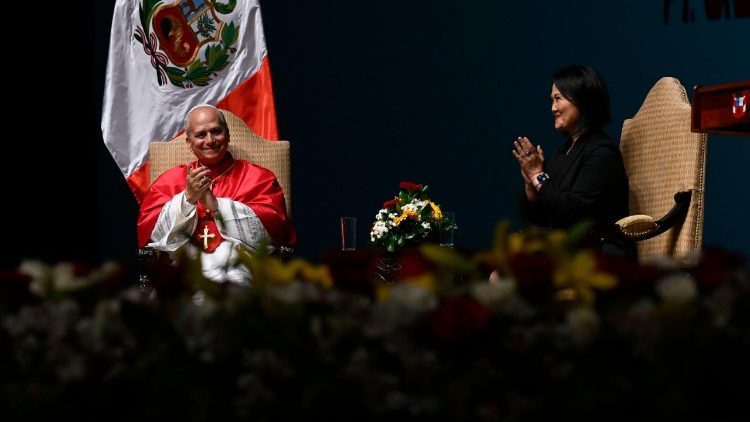
Back in Peru—a country he called home for more than two decades—Pope Leo XIV spoke to authorities and members of the diplomatic corps in his first public address at the “Gran Teatro Nacional” in Lima.
“This return visit holds a very special meaning for me,” he explained, adding that his connection to Peru began long before he was the bishop of Chiclayo. “For many years, I shared in the lives of its people, listened to their concerns and learned from their faith,” the Pope shared.
He remembered the people who opened their homes to him, particularly sharing “some good ceviche” with him, making him feel “like one of their own.” In 2015, Pope Leo received Peruvian citizenship—an act, he highlighted, that “gave formal recognition to a bond that the people of this country had been weaving into my life long before.”
Standing in the capital city, he said he understands “how much of this land remains with me, and how much of my own story also belongs to all of you.”
“Today I understand how much of this land remains with me and how much of my own story also belongs to you.”
Returning to Peru now as the Successor of Peter, the Pope noted that his years in the country helped form him as a shepherd. He expressed gratitude for his time in Peru and for the opportunity to return.
A shared national destiny
Pope Leo then turned to many languages and traditions that mark the culture of the country. Almost 500 years ago, the Catholic faith reached the shores of Peru and the first saint of Latin America came from Peru—St. Rose of Lima.
While the different regions of Peru maintain their own traditions, the Pope underlined how the “unity of a people is strengthened when these differences are given their rightful place and each person contributes from the perspective of their own history and convictions.”
The country expresses solidarity through shared work projects, help for families, and hospitality. These are ways in which someone can find ways of showing their love for their country.
He stressed that “to love a people means to desire that everyone may live with dignity in their homeland, to take an interest in their well-being and to be willing to give something of oneself for the common good.” Something he said he understands better thanks to the people of Peru.
Concern for others is embodied in public service and democratic life that can bring people of different beliefs and goals together, united through a “shared national destiny.”
Real people, real life
The Pope explained that listening is an essential first step in understanding the needs of others, especially in a country with many languages. Beyond the files, paperwork and the census numbers, there are real people.
Listening demands a special patience when disagreements and painful experiences arise. “Democratic life requires us to recognise that no one has all the answers, and that our differences do not prevent us from sharing a sincere concern for the good of our country,” Pope Leo urged.
“Democratic life implies recognizing that no one has all the answers and that differences do not prevent us from sharing a sincere concern for the good of the country.”
He challenged them to cultivate honesty, integrity, and a willingness to engage with others.
Peace has a concreate meaning for families, the Pope explained: going to work without being afraid, caring for one’s children, and returning home with a peace of mind. No one should be deprived of these “simple aspirations.”
He noted that the Church “knows the suffering caused by violence and wishes to remain close to those who endure it, encouraging the efforts of all who work to protect human life, dignity and rights through the rule of law and justice.”
Providing for one’s family also makes up a part of this “everyday peace.” Each job plays a role in the life of the country and each has a dignity that should be recognized.
There are certain goods that cannot be replaced by economic prosperity: “peace of conscience, the certainty of being loved and the freedom to seek the truth and shape one’s life in accordance with it.”
Dialogue and cooperation
Pope Leo urged authorities provide accessible health services and to strength preventive medicine in order to support families who care for the elderly, the sick, those with mental health challenges and those with disabilities.
While praising the positive advances in science and technology in regards to healthcare, educational opportunities, and the environment, the Pope also called for “appropriate legal safeguards are also necessary to prevent potential abuses and protect people from their consequences.”
He pointed out that environmental protection and the responsible use of new technologies needs collaboration among countries. Issues affecting people of different regions and nations “can be addressed more effectively through dialogue and cooperation.”
Thinking of the many Peruvians who live abroad, the Pope stressed that “distance does not necessarily diminish one’s love for one’s homeland; sometimes it allows us to recognise more clearly just how much we have received from it.”
Wars and conflicts that affect people worldwide demand patient diplomacy, which Pope Leo described as a diplomacy, “one that keeps dialogue open, respects international law and seeks agreements that safeguard human life and dignity.”
While every nation has its own legitimate ambitions, the fortunes of one are inseparable from those of others.
A reciprocal relationship
Closing his speech, Pope Leo explained that the relationship between Peru and the Holy See are based in the spirit of regional and international cooperation. The Peruvian Constitution recognizes the Catholic Church as a significant part of the historical, cultural, and moral formation of the country and helps in the collaboration between Church and State.
The Church continues to offer Peru its mission of proclaiming the Gospel, walking with those who suffer, and serving the dignity of every human being.

“This return visit holds a very special meaning for me,” the Pope shared. (VATICAN MEDIA)
There are numerous ways to serve Peru, the Pope said, offering his gratitude to all who serve. “I have received so much from you. There are faces, conversations and gestures of affection that, after all these years, remain with me,” he shared.
He proposed the Social Doctrine of the Church as “guidance and inspiration for all those working for the good of this nation.”
“Through the intercession of the Blessed Virgin Mary, Saint Rose and all the saints and blesseds of this land, I ask the Lord that the love of Christ may help you recognise in every Peruvian a brother or sister, and in each one of them, yet another reason to love your homeland.”
Thank you for reading our article. You can keep up-to-date by subscribing to our daily newsletter. Just click here.
© Dicastery for Communication – Vatican News